For many enterprise organizations, Jira and Confluence have become core parts of daily work.
Jira helps teams manage projects, tasks, workflows, backlogs, priorities, and progress.
Confluence helps teams store documents, meeting notes, processes, product requirements, knowledge bases, lessons learned, and internal knowledge.
At the same time, many organizations are also using different AI tools such as Microsoft Copilot, ChatGPT, Claude, or other AI assistants. These tools can help employees write content, summarize documents, search for information, and complete daily tasks faster.
But there is still one big problem.
Even when a company already uses Jira, Confluence, and many AI tools, it may still not get the full value from its work data and knowledge.
Information exists in the system, but employees still spend a lot of time searching for it. Documents exist in Confluence, but they do not always become clear actions in Jira. Meetings happen every day, but many decisions and context still stay outside the workflow. AI is used, but it is often disconnected from the real work system.
This is where Teamwork Collection can help.
Atlassian Teamwork Collection brings Jira, Confluence, Loom, and Rovo together. It helps enterprises connect work, knowledge, communication, and AI in one common way of working.
Jira and Confluence Are Important, But They Are Only Two Pieces
Jira and Confluence are powerful tools. For large companies, they are often already part of the operating system for work.
Jira helps teams manage work in a clear structure. Each task can have an owner, status, deadline, priority, and activity history. For IT, product, PMO, operations, and digital transformation teams, Jira helps turn complex work into something that can be tracked, managed, and improved.
Confluence helps companies manage knowledge. Important documents such as processes, plans, meeting notes, policies, internal guides, product requirements, operation documents, retrospectives, and lessons learned can be stored in one shared space.
When used well, Jira and Confluence help reduce scattered information across email, personal files, chat groups, and spreadsheets.
However, in many enterprises, Jira and Confluence are still used in a traditional way:
Jira is used mainly to track tasks.
Confluence is used mainly to store documents.
Meetings, discussions, feedback, and decisions still happen outside the system.
AI is used at the personal level, but not deeply connected to the workflow.
Different teams still use different tools, which creates more data silos.
This means the company already has a strong foundation, but it may not be using the full value of that foundation.
An AI-Native Workplace needs more than a task management tool and a document storage space. It needs a connected system where goals, work, knowledge, communication, and AI all work together.
This is the gap that Teamwork Collection can close by extending Jira and Confluence with Loom and Rovo.
Three Hidden Gaps That Waste Enterprise Value
Gap 1: Information Exists in the System, But Employees Still Spend Too Much Time Searching
After many years of using Jira and Confluence, an enterprise may have a huge amount of valuable data.
This can include thousands of issues, documents, meeting notes, decisions, processes, roadmaps, backlogs, lessons learned, and project reports.
In theory, this is a valuable business asset. But in reality, employees may still spend a lot of time looking for the right information.
A document may already be in Confluence, but no one remembers which space it is in. A decision may already be written in a meeting note, but it is not linked to the right Jira task. A Jira issue may include important context, but a new team member does not know which part to read first.
So when people need an answer, they still have to ask coworkers, search through chat, open many Confluence pages, check old Jira issues, or look through different files.
This is a common waste in large organizations. The problem is not that the company lacks information. The problem is that information is not easy enough to find, understand, and use in the right context.
With Teamwork Collection, Rovo helps solve this gap by bringing AI into the Atlassian work system.
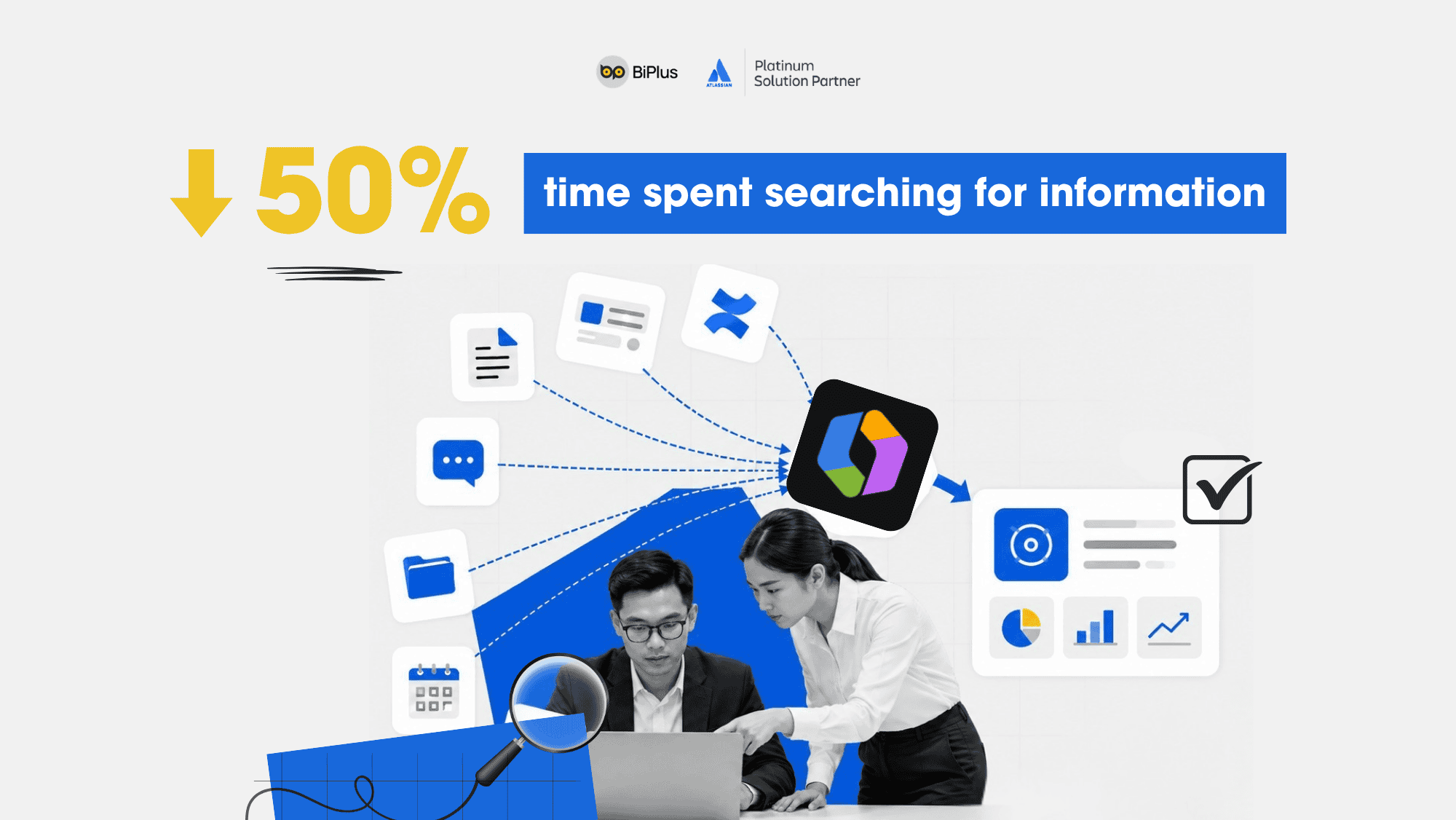
Rovo helps users search and understand knowledge in the context of work. It can help answer questions such as:
Which document is related to this task?
Which decision affects this project?
Which issue is connected to this problem?
Which information can help the team make a better decision?
When Rovo works with data from Jira, Confluence, and other related sources, it helps unlock hidden value inside the system. Instead of making employees search manually, AI can help find, summarize, and organize information in a more useful way.
Teamwork Collection can reduce the time needed to search for information by 50%. For a large enterprise, this is not just a small time saving. If hundreds or thousands of employees save time every week, the business impact can be very significant.
According to Atlassian's report, Driving Productivity and Business Outcomes by Bridging Enterprise-wide Collaboration.
Gap 2: Meetings, Discussions, and Decisions Still Stay Outside the Workflow
Jira has tasks. Confluence has documents. But in real work, a lot of important context is created in meetings, review sessions, product demos, stakeholder discussions, and customer feedback calls.
After a meeting, the team may create tasks in Jira or write meeting notes in Confluence. But if the meeting context is not captured well, many important details can be lost.
For example, a Jira task may say: "Update the change approval process."
But why does the process need to be updated? Which step is causing the problem? Who gave feedback? What risk was discussed in the meeting? What was already agreed, and what still needs to be checked?
If someone only reads a short Jira task, they may know what to do. But they may not understand why the task matters. If they only read a long Confluence page, they may understand the content, but still miss the real discussion, tone, and priority behind it.
This is why Loom is an important part of Teamwork Collection.
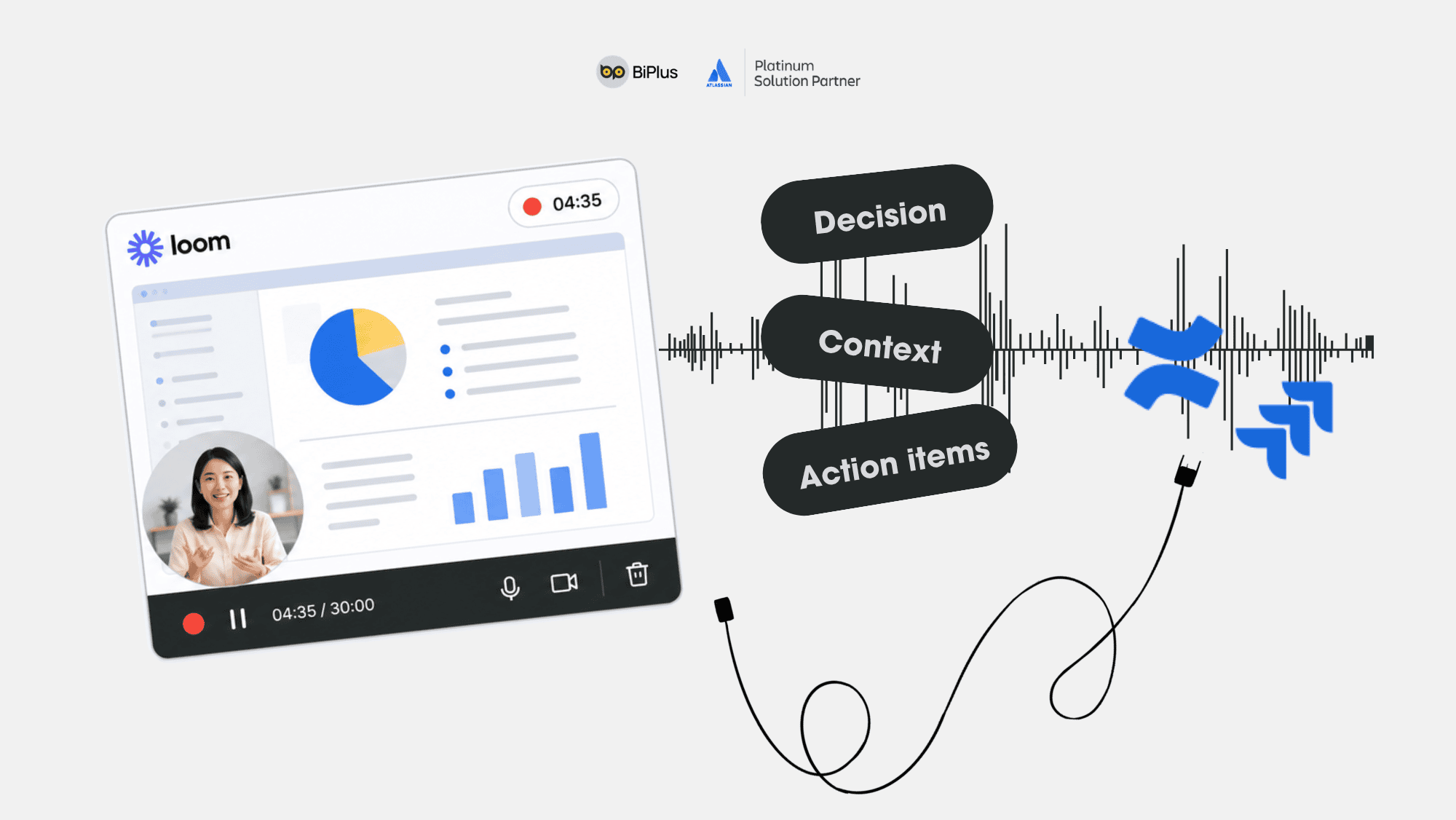
Loom helps teams record and share context through video. Instead of holding another meeting just to explain the same thing again, a team member can record a short video to explain a problem, show a demo, review a design, explain a workflow, or give a project update.
The viewer can understand not only the content, but also the thinking process, the reason behind the decision, and the key points to focus on.
When Loom is connected with Confluence and Jira, video is no longer just a separate file. It becomes part of the work and knowledge system.
A demo video can be linked to a product document. A feedback video can be connected to a Jira issue. A meeting recording can be summarized into action items and connected to the next tasks.
This helps enterprises reduce repeated meetings, reduce repeated explanations, and help people who did not attend the meeting catch up faster.
Gap 3: Knowledge Exists in Confluence, But It Does Not Always Become Action
Another common problem in large enterprises is that Confluence may contain a lot of knowledge, but not all knowledge becomes action.
Meeting notes may be well written, but action items are not always created as Jira tasks. A strategy document may already be approved, but it is not linked to the roadmap or backlog. A process may be published, but each team still follows it in a different way. A lesson learned after one project may be stored in Confluence, but not reused in the next project.
The waste is not caused by a lack of documents. The waste happens because documents do not always create real business action.
Teamwork Collection helps connect knowledge and action by combining all four tools
Loom captures meeting context, demos, feedback, and discussions.
Confluence stores, organizes, and shares knowledge.
Jira turns knowledge into trackable work.
Rovo helps summarize, search, suggest, create workflows, and bring AI into the work process.
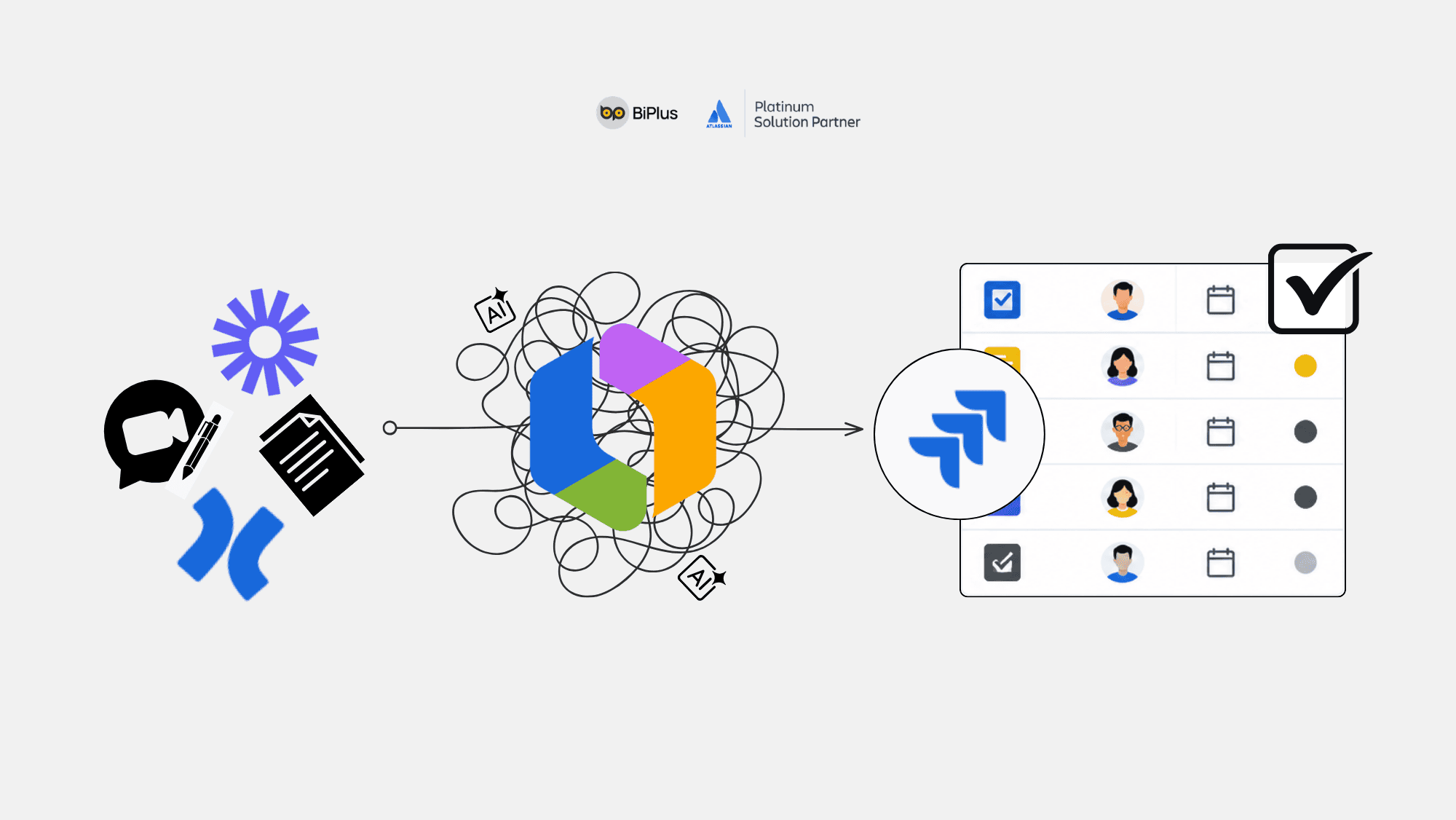
For example, a meeting about a digital transformation plan can be recorded with Loom. The key points, decisions, and action items can be summarized in Confluence. From there, the action items can become Jira work items. Rovo can help improve task descriptions, suggest subtasks, find related documents, and help the team understand the context before starting the work.
In this way, knowledge does not stay static in a document. It becomes action, workflow, and business results.
This is the key difference between "having Jira and Confluence" and "working with Teamwork Collection."
With Jira and Confluence alone, the company can manage tasks and store documents. With Teamwork Collection, the company can connect the full lifecycle of work: from ideas, meetings, and documents to decisions and execution.
From Jira and Confluence to Teamwork Collection: What More Does the Enterprise Get?
Teamwork Collection does not replace Jira and Confluence. It helps enterprises get more value from them by adding Loom and Rovo, and by connecting all four tools in one work system.
| Area |
With Jira + Confluence Only |
With Teamwork Collection |
| Work management |
Jira helps track tasks, progress, workflows, and responsibilities. |
Jira is connected with documents, video context, and AI support, so work has more context. |
| Knowledge management |
Confluence stores documents, meeting notes, processes, and knowledge bases. |
Confluence becomes a shared workspace for both humans and AI, where knowledge can be searched, summarized, and turned into action. |
| Team communication |
Context often stays in meetings, chat, email, or separate discussions. |
Loom records and shares context through async video, reducing repeated meetings and repeated explanations. |
| AI usage |
AI is often used by individuals or in separate apps. |
Rovo works inside the Atlassian ecosystem and helps AI understand work, documents, tasks, and related context. |
| Information search |
Users search across many pages, issues, files, or ask coworkers. |
Rovo helps search, summarize, and answer based on work context. |
| Turning knowledge into action |
Meeting notes and documents may not be connected to execution tasks. |
Content from Loom and Confluence can be connected to Jira work items, so action items are tracked to completion. |
| Organization productivity |
Improvement often happens only inside one team or one process. |
Teams can work better across the organization, reduce silos, save search time, and improve project success. |
| Tool cost and governance |
The company may still use many overlapping collaboration tools. |
The company can consolidate tools, reduce admin cost, and improve technology ROI. |
Organizations using Teamwork Collection have seen an average 31% increase in project success rate. Teamwork Collection can also reduce the time needed to search for information by 50%. Rovo users can save around 1-2 hours every week, or 50-100 hours per person each year.
According to Atlassian's report, Driving Productivity and Business Outcomes by Bridging Enterprise-wide Collaboration.
For large enterprises, this is not only about personal productivity. It is also about improving how the whole organization works, makes decisions, and turns knowledge into results.
When Should an Enterprise Consider Upgrading to Teamwork Collection?
An enterprise should consider Teamwork Collection if it sees one or more of these signs:
The company has used Jira and Confluence for years, but mainly for task tracking and document storage.
Employees still spend too much time searching for information, asking for context, or checking which document is the official version.
Meeting notes exist, but action items are not always turned into Jira tasks and tracked to completion.
The company uses AI tools such as Copilot, ChatGPT, or Claude, but AI is still not connected to the Atlassian workflow.
Non-IT teams still work across many separate tools, which creates information silos and makes governance harder.
Leaders want to improve productivity at the organization level, not only at the individual level.
IT and admin teams want to reduce duplicate tools, optimize cost, and standardize the way teams work.
The company wants to build an AI-Native Workplace, but does not yet have a connected system for goals, work, knowledge, and communication.
If these problems happen often, the company may not need another separate AI tool first. What it needs is a better way to connect the work system so existing tools can create more value.
>> Readmore: Teamwork Collection - A strategic solution for digital and AI-Native operations
AI-Native Workplace Does Not Start With an AI Tool. It Starts With How Work Is Organized.
In the AI era, business value does not only come from buying one more AI tool.
Real value comes when AI is placed inside the right work system. AI needs to understand the full context of work, including goals, tasks, documents, meetings, decisions, and the relationships between teams.
Teamwork Collection helps enterprises extend the value of Jira and Confluence with Loom and Rovo.
- Loom adds the missing layer of communication context.
- Rovo helps unlock knowledge and bring AI into the workflow.
- Jira and Confluence remain the core foundation, but they become part of a more connected, more intelligent, and more AI-ready work system.
If your company has used Jira and Confluence for years but still faces information silos, too many meetings, hard-to-find context, or disconnected AI usage, now is the right time to review how you use Atlassian.
BiPlus can support your enterprise in assessing the current state, identifying wasted value, and building a practical roadmap for Teamwork Collection adoption.
Talk to BiPlus to discover how Jira, Confluence, Loom, and Rovo can help your organization make better use of your existing Atlassian foundation and move closer to an AI-Native Workplace.
Contact us!