AI-Native Developer: When AI Is No Longer a Tool, but the Way You Work
You are using AI every day. The question is not whether you use it a lot or a little. The real question is: if you leave tomorrow, does your AI experience stay with the team?
This is the problem happening in many software development teams today. AI is used everywhere, but the way teams work has barely changed. Each developer uses AI differently, solves tasks individually, and builds their own habits. However, none of that creates a shared way of working that can be repeated, scaled, or transferred to others.
This is where the concept of AI-Native appears.
AI-Native is not about being better at using AI tools than others. It is about redesigning the way you work, and eventually the way your team operates, with AI embedded into the workflow instead of sitting outside of it as a separate tool. At that point, AI does not just help individuals move faster. It helps the team deliver better in a structured and repeatable way.
Why Developers Use AI but Still Struggle to Improve
In reality, most developers today already use AI in their daily work. However, the overall impact is still far below expectations. The issue is not the tools themselves. The issue is how they are being used.
Right now, AI mostly stays at the individual level. Each developer uses Cursor, Claude Code, or Copilot differently. Everyone has different prompts, different ways to validate output, and different standards. As a result, AI becomes a personal advantage, not a team capability. What one developer learns from AI is difficult to share, standardize, or scale across the team.
At the same time, AI is still not truly integrated into the software development workflow. Most teams use it only when needed, instead of embedding it into requirement analysis, coding, code review, or system optimization. Because of that, AI may improve small tasks, but it does not improve the overall delivery process.
In some cases, speed increases while quality becomes harder to control. A recent report from GitClear showed that AI-generated code has a significantly higher duplication rate compared to manually written code. Teams move faster, but technical debt grows as well. Code is generated faster, but it becomes less consistent, harder to maintain, and more likely to introduce issues.
This is the limitation of simply "using AI." And this is exactly why developers need to move toward becoming AI-Native.
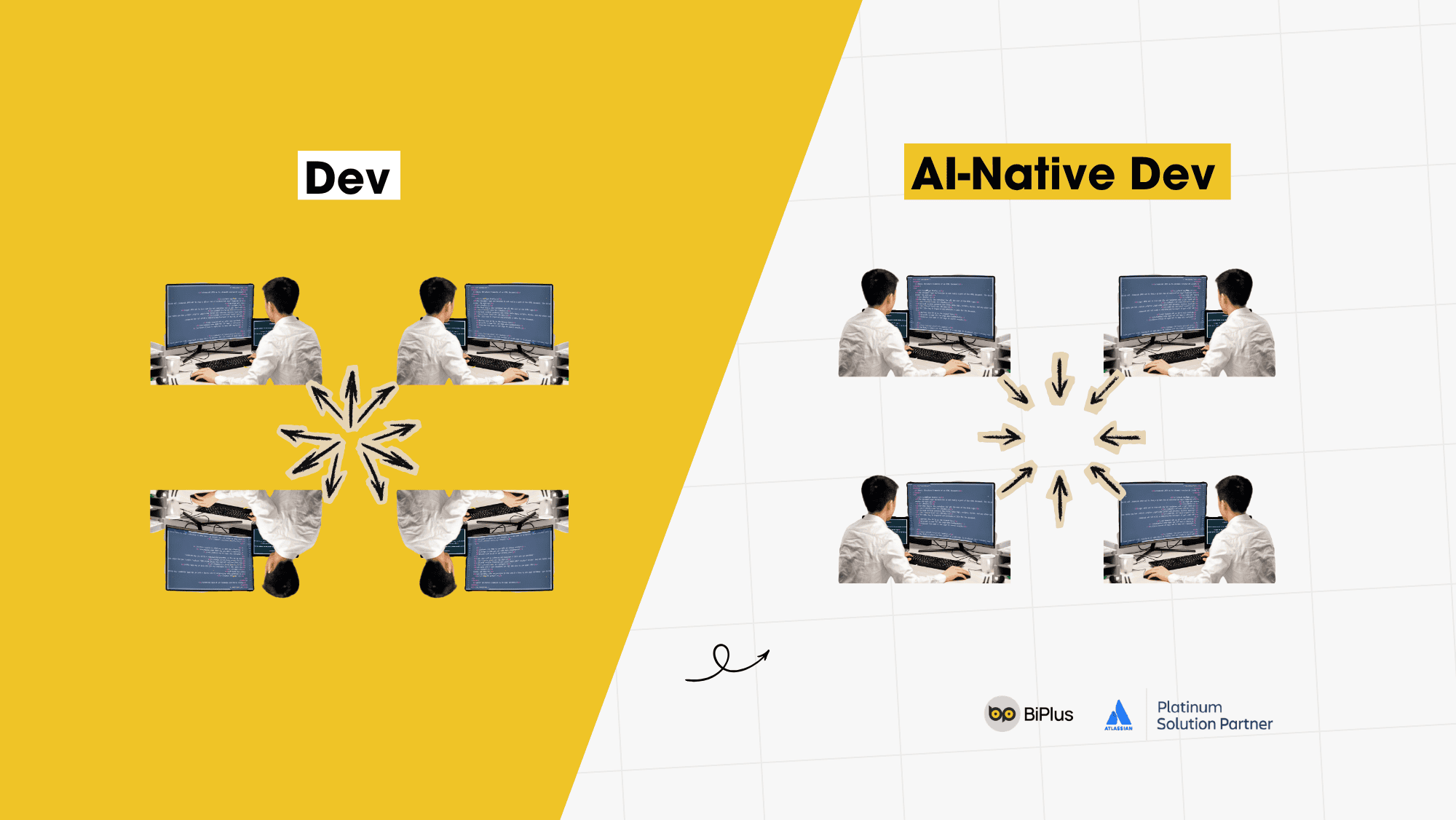
The difference starts with how developers define their role. A traditional developer focuses on writing code faster and better, using AI as a supporting tool. An AI-Native Developer goes beyond that. They design how code is created, reviewed, improved, and controlled with AI. Instead of optimizing individual productivity, they optimize how the team works.
The Roadmap to Becoming an AI-Native Developer
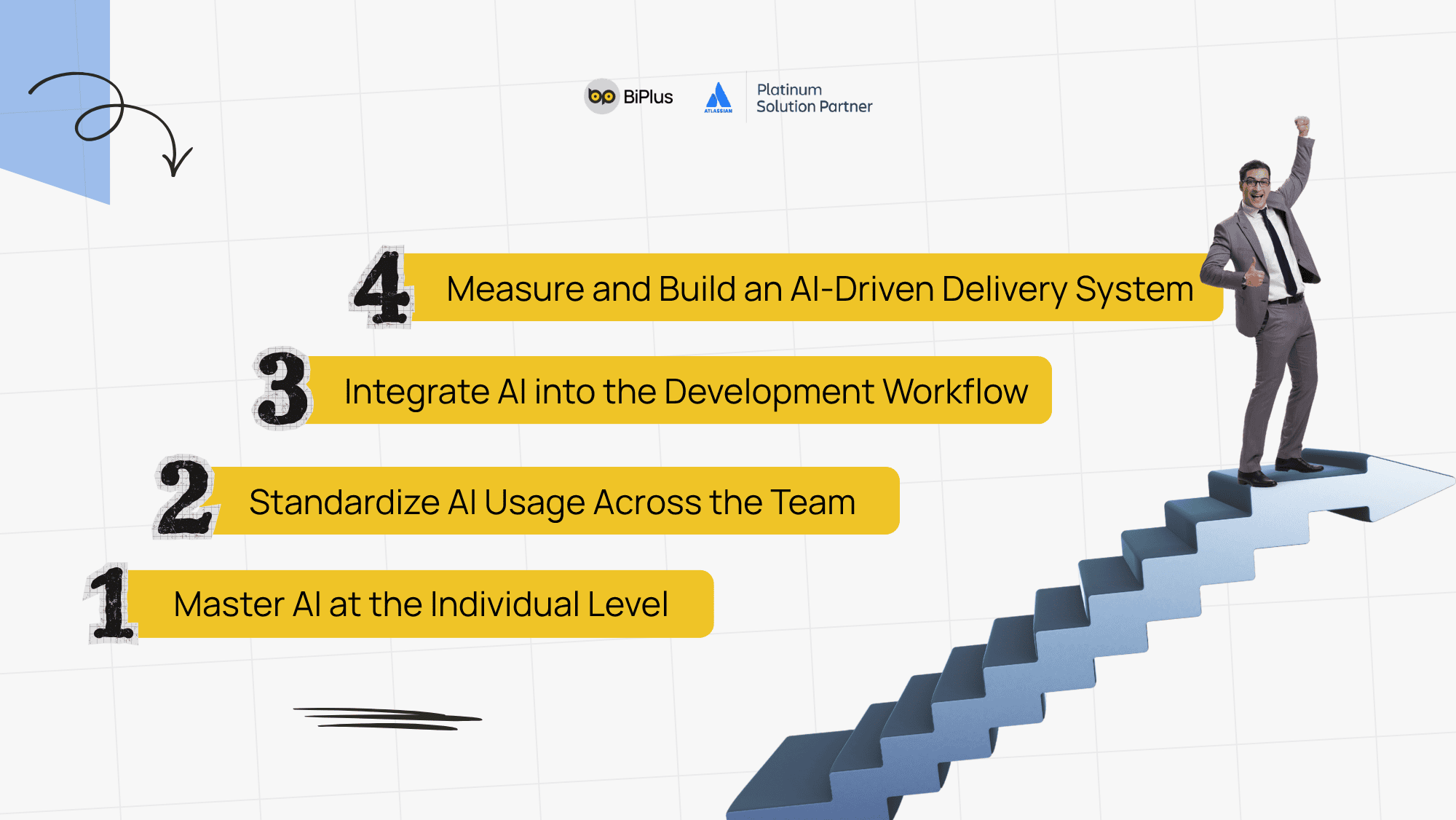
Becoming AI-Native does not happen in one step. It is a gradual shift from individual usage to team capability, and eventually to system-level operation.
Stage 1: Master AI at the Individual Level
The first stage is learning how to work effectively with AI yourself. This goes beyond writing good prompts. Developers need to understand when AI should be used, how to validate outputs, and how to avoid blindly depending on generated results.
At this stage, AI mainly improves individual productivity. You can code faster, debug faster, and spend less time on repetitive tasks. However, this is only the starting point.
It is also the most common trap. Many developers stop here and assume they are already AI-Native.
Stage 2: Standardize AI Usage Across the Team
As more developers start using AI, inconsistency becomes the next challenge. This is the stage where teams need to build shared ways of working.
The team begins defining where AI should be used inside the workflow. Shared context files such as CLAUDE.md or .cursorrules are introduced. Prompt templates and MCP servers connected to internal documentation become part of the environment. Teams also start sharing best practices between developers.
The goal of this stage is simple: transform AI from a personal advantage into a transferable team capability.
Stage 3: Integrate AI into the Development Workflow
This is the stage where AI becomes part of the delivery process itself.
AI is integrated directly into software development activities through tools such as Claude Code subagents, Cursor rules, or MCP servers connected to internal systems. Developers begin using AI to support requirement analysis, generate code following team standards, assist code reviews, create test cases, and improve documentation.
At this point, AI no longer sits outside the workflow. It becomes part of the workflow.
This is also the moment when AI starts creating value at the team level instead of only improving individual productivity.
Stage 4: Measure and Build an AI-Driven Delivery System
Once AI is integrated into the workflow, teams need to start measuring impact.
The focus is no longer "how often AI is used," but:
delivery speed
bug count
issue resolution time
code maintainability
For example, before integrating AI into code review, a team may spend two days on average to merge a pull request. After introducing AI into the first-pass review process, that time can be reduced to half a day - but only when the team clearly defines what AI decides and what humans decide.
Based on these metrics, teams begin optimizing AI usage, standardizing workflows, creating reusable patterns, and building systems that can scale.
This is the stage where you move from being someone who writes code to someone who designs delivery systems.
Core Skills of an AI-Native Developer
To move through this journey, developers need to develop several important capabilities.
Systems thinking is critical because AI should be seen as part of a larger system involving people, processes, and tools, not as an isolated utility.
Workflow design becomes increasingly important as developers need to understand how AI should operate throughout the software development lifecycle, not just within individual tasks.
Developers also need practical AI literacy. You do not need to become an AI researcher, but you need to understand what AI can do, what it cannot do, and how to validate its output effectively.
An experimentation mindset is equally important. AI-native workflows are rarely perfect from the start. Teams need to continuously test, adjust, and improve the way they work.
Finally, developers need a strong quality mindset. Speed is valuable, but not if it comes at the cost of maintainability, reliability, and long-term stability.
>> Explore the Business Case at BiPlus to see how AI-Native transforms the SDLC into a strategic operational capability for enterprises.
Career Opportunities for AI-Native Developers
Before discussing career paths, there is one important reality to acknowledge: AI is compressing many junior-level roles.
A developer who knows how to operate effectively with AI can now complete work that previously required a small team. This creates both opportunity and pressure. AI-Native Developer is not just a title. It is how you make sure you are on the opportunity side of that change.
AI will not replace developers, but it will absolutely change how developers create value.
Today, many developers gain an advantage simply by using AI to improve personal productivity. However, this advantage will not last forever. As AI becomes standard across the industry, "using AI" will no longer be a differentiator.
The real difference will come from what you can do with AI at the team and system level.
When you become an AI-Native Developer, you stop solving only your own problems. You begin improving how the entire team works. This shift becomes a major career advantage.
Expanding into Leadership and System Roles
From a developer role, you can grow into positions such as Tech Lead or Engineering Lead, where your responsibility goes beyond coding. You start shaping how teams work with AI, improving delivery quality, and increasing team efficiency.
Beyond leadership roles, you can move into positions such as Platform Engineer or Developer Experience (DevEx) Engineer. These roles focus on designing workflows, systems, and environments that help developers work more effectively. In the AI era, this is no longer just about building tools. It is about designing how AI operates inside the software delivery process.
At a higher level, you may participate in system design and organization-wide technical operations. Roles such as Principal Engineer, Architect, or Head of Engineering increasingly require this capability, especially in large enterprises and global organizations.
The common point across all these roles is clear: you are no longer evaluated only by personal output, but by your ability to create impact at a larger scale.
Becoming an AI-Native Developer with BiPlus
If you are a developer who wants to move from simply "using AI" to "working with AI" in a structured way - and you want an international certification to validate that capability - the AI-Native Foundation program is designed for you.
The program does not focus on AI theory. Instead, it focuses on applying AI directly to real development workflows.
You will learn how to combine Agile and AI to design more effective workflows for development teams. You will build AI practices that can be applied at the team level, not just individually. You will also join a community that continuously shares new approaches and workflow improvements.
The program includes the international certification "Certified AI-Native Foundations Professional" from Scaled Agile, helping developers demonstrate their capability in a market where AI is becoming the new standard.
The program is especially suitable for:
>> Learn more about the program at the AI-Native Foundation Class by BiPlus.