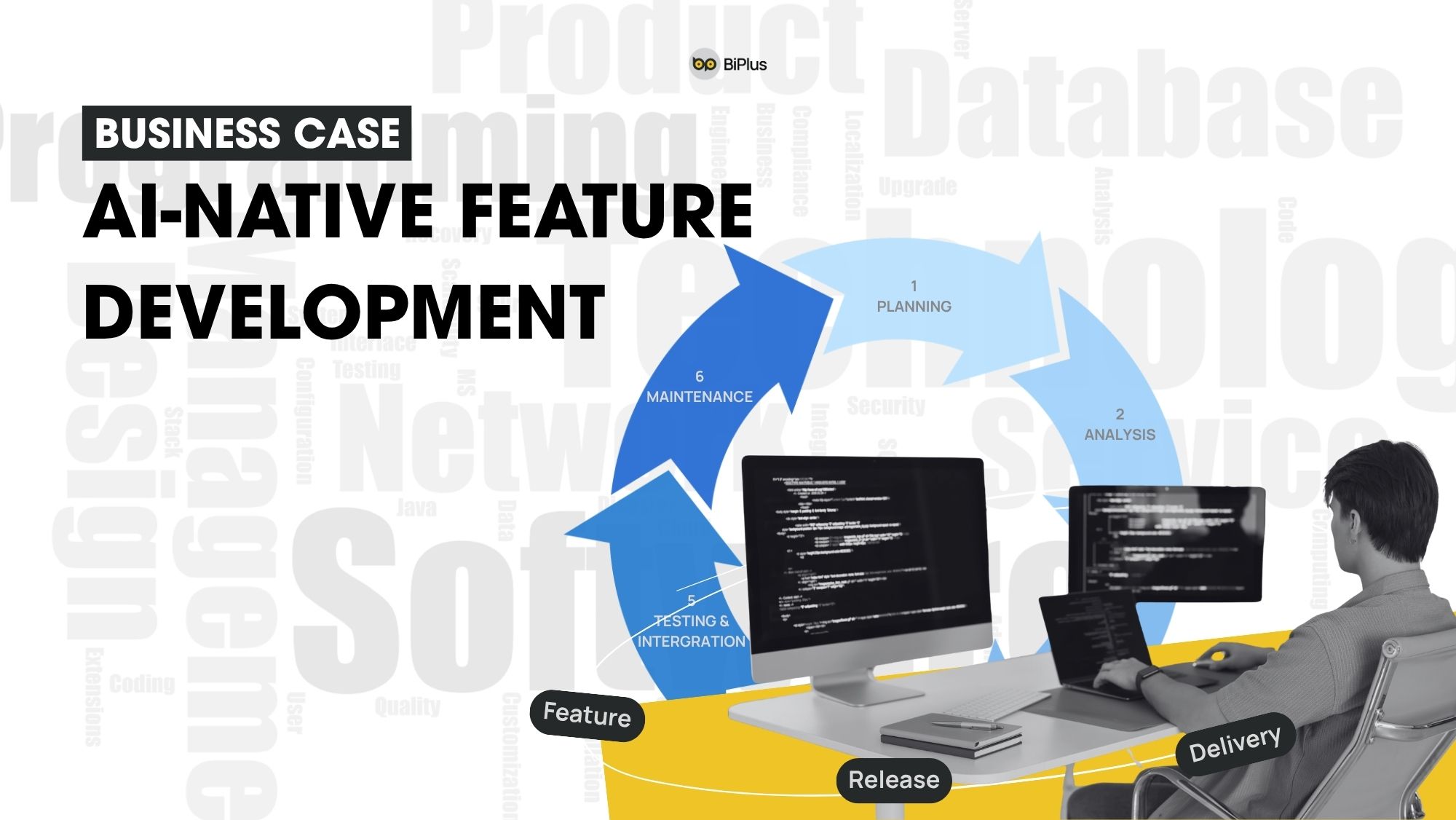
At BiPlus, software development is not treated as a purely technical activity. It is a core operating capability that directly determines how fast features ship, how reliable releases are, and how effectively delivery can scale across the organization. As complexity grows and systems become more interconnected, the SDLC is no longer just a sequence of technical steps. It becomes a value creation system that must be intentionally designed.
As BiPlus positions itself as an AI-Native organization, the key question is not whether AI can help engineers code faster. The question must be reframed at the system level: if the SDLC continues to operate under its traditional model, will it turn into a strategic bottleneck on the growth journey?
Because of that, AI-Native transformation does not start from tools. It starts from rethinking the Operating Model of the entire software development process.
Good processes are not the same as scalable capability
Before introducing AI-Native Feature Development, the engineering teams at BiPlus already had what many organizations are aiming for: structured processes, modern tooling such as Jira, Confluence, CI/CD pipelines, and experienced engineers. On the surface, the delivery system looked mature and reasonably optimized.
However, a closer look at each touchpoint along the delivery chain revealed a structural value gap.
Product requirement documents kept getting longer and went through multiple versions, which led to developers and QA interpreting the same requirement differently. Requirements were spread across multiple places, making it time consuming to assemble full context. Change impact analysis relied heavily on a small group of senior engineers with deep system knowledge. Onboarding new team members took considerable time because they needed to understand complex legacy systems. And test cases did not always cover edge cases, leaving a real risk of rework after UAT or even in production.
These issues were not caused by a lack of tools or a lack of talent. BiPlus had the data, the systems, and high quality people. The real gap was that AI had not yet been formally embedded into the value creation workflow. When AI is only used as an individual, disconnected helper, it lacks system wide context, it is not tied to delivery KPIs, and it does not sit inside any audit or governance framework. As a result, the value created is hard to measure and cannot be scaled at the organizational level.
AI-Native means redesigning how the organization creates software
In many organizations, AI adoption starts as personal assistance. Each individual uses AI on their own terms, for example to generate code, summarize documents, or draft content. This may improve productivity at the individual level, but it rarely drives real change at the system level.
AI-Native Feature Development at BiPlus follows a different approach. Instead of treating AI as an external tool, the team treats AI Agents as digital team members inside the System of Work. Each agent is designed with a clear name, a defined scope of responsibility, and direct integration into operational systems such as Jira, Confluence, and code repositories.
To make this work in practice, workflows must be redesigned. Input data must be standardized. Governance mechanisms must be put in place to ensure transparency and accountability. Most importantly, the value created must be measured and continuously improved through each iteration cycle. This is not about switching AI on inside existing tools. It is about redesigning the Operating Model of the SDLC.
From manual SDLC to an AI-Native System of Work

Previously, most SDLC stages depended on manual human effort. Analyzing PRDs, breaking them down into user stories, performing change impact assessments, and building test cases were all based on individual experience and skill. When AI appeared, it was used in an ad hoc manner and did not play an official role in the value chain.
With the shift to an AI-Native model, the operating structure changes in concrete ways. PRDs are standardized so they can be treated as structured input data. AI Agents analyze documents, propose user story breakdowns, and create tasks in Jira, including dependencies. Developers can focus on high value technical decisions instead of spending time on repetitive decomposition tasks. QA moves from writing tests from scratch to quality control and risk assessment. Management gains near real time visibility into progress and risks based on system data instead of depending on manual reporting.
The core change is not about replacing people. It is about shifting humans from doing all the work manually to orchestrating and governing an intelligent system.
Designing AI Agents for specific bottlenecks
Instead of building a single, generic agent, the BiPlus team started by identifying concrete bottlenecks in the SDLC and then designed specialized agents for each one.
PRD Clarifier is designed to solve ambiguity in specification documents. The agent analyzes PRDs in Confluence, proposes standardized user stories and acceptance criteria, and links them directly with Jira to maintain end to end traceability between documentation and execution. Business analysts or product owners keep the review role and make the final decision before items enter the sprint.
Impact Analyzer focuses on change impact analysis. By referencing the codebase, documentation, and ticket history, the agent helps identify impacted areas and summarizes relevant architectural decisions. This reduces reliance on a few senior engineers who were previously the only ones holding deep system context.
Test Case Generator produces test cases from acceptance criteria and suggests additional edge and negative cases. QA is not replaced. Instead, QA shifts towards validating the test suite, ensuring coverage and alignment with business risk.
Each agent operates within a clearly defined scope, with appropriate access permissions and activity logs to ensure accountability. After every sprint, the team evaluates the agent impact, measures realized value, and refines agent behavior based on operational data. As a result, value does not come from a single better prompt. It comes from workflow design and consistent governance.
The outcome is not just about speed
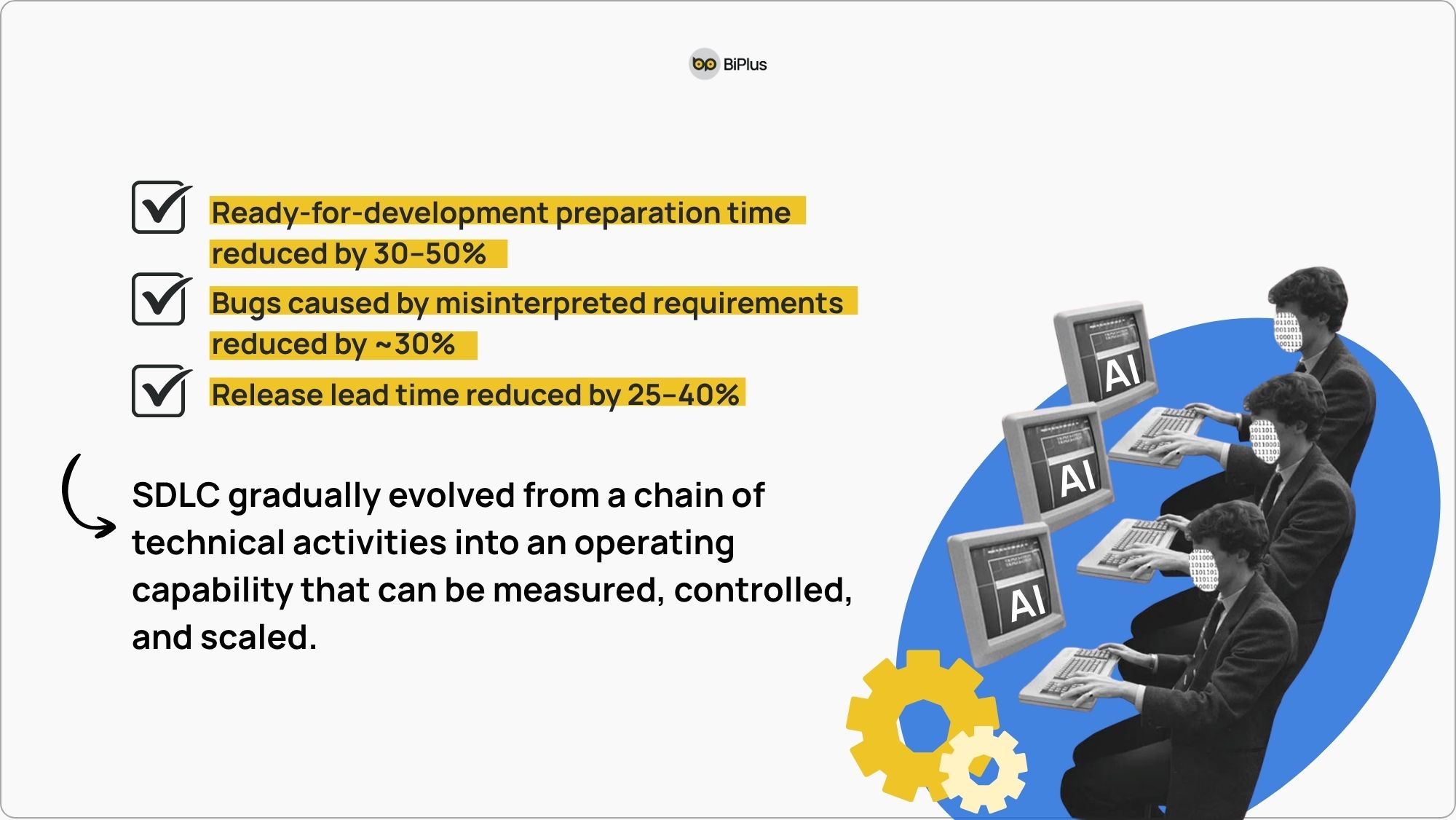
After implementing AI-Native Feature Development, the time from PRD to ready for dev status decreased significantly, typically by 30-50% depending on feature complexity. Bugs caused by misunderstood requirements dropped by around 30%. Release lead time was shortened by 25-40%.
However, the more important impact lies in the operating structure. Developers and QA engineers spend far less time on repetitive work. Onboarding new members becomes faster because the system itself can provide richer, more structured context. Management gains clear visibility into risks and progress instead of relying on manual reporting. AI adoption happens inside a controlled framework, which avoids concerns over security and accountability.
The SDLC gradually evolves from a chain of technical activities into an operating capability that can be measured, governed, and scaled.
AI-Native as a long term operating capability
AI-Native Feature Development at BiPlus is not a short lived pilot. It is built as a strategic operating capability, with a clear roadmap and continuous improvement mechanisms.
When AI is embedded properly into the System of Work, the software development process becomes not only faster, but also more stable, more transparent, and easier to scale over time. This is not simply about AI writing code instead of humans. It is about redefining how an organization builds software in a world where AI becomes part of the core delivery capability.
In the end, the real difference is not whether AI is used or not. The difference is whether AI operates as a disconnected helper or is designed as a structural component of the Operating Model. That is the boundary between experimenting with technology and redesigning operating capability.
From concept to operational reality
At BiPlus, AI-Native is not just a topic for presentations. It is a capability that we are committed to building into the operating system of the organization. We work with businesses from the very beginning: clarifying the problem, redesigning workflows with an AI-Native mindset, defining the role of AI Agents at each touchpoint, and staying until the model actually runs in real operations.
For BiPlus, AI-Native is not a thin layer of technology on top of outdated processes. It is a restructuring of how the organization operates and how humans and AI work together inside a new System of Work. We join as an implementation partner and walk alongside internal teams through the entire journey, to ensure AI is not only introduced into the system but becomes part of a long term operating capability.