Over the past two years, AI has become a constant topic in digital transformation conversations. Organizations invest in new tools, teams experiment with chatbots, automate reports, and embed AI into daily tasks, all with the expectation of achieving faster execution and lower costs.
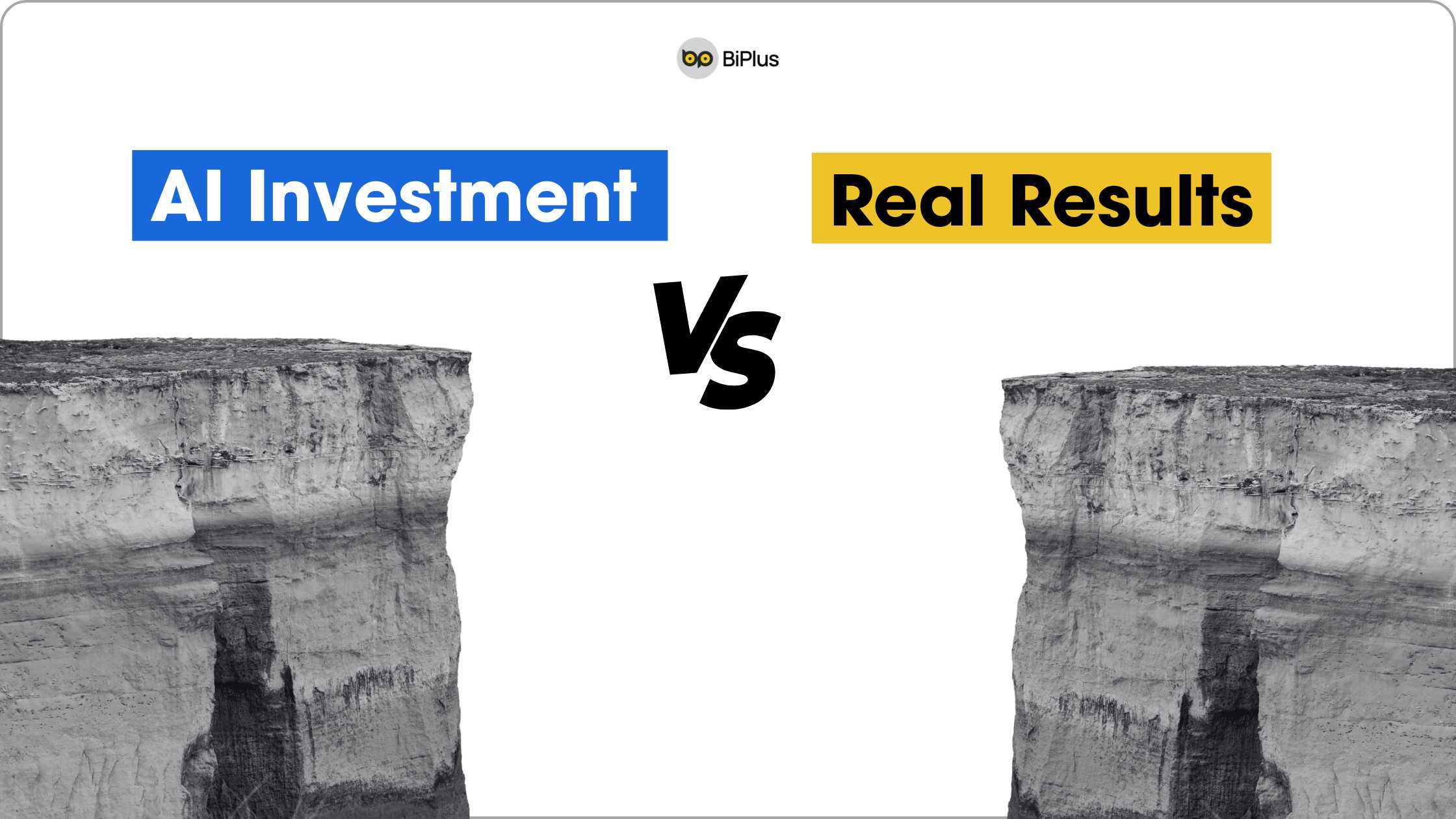
However, the reality often looks very different. Many companies find themselves using more AI than ever, while productivity stagnates or even declines, and operational complexity quietly increases. This gap between expectation and outcome is not just anecdotal; it is increasingly reflected in data.
According to S&P Global Market Intelligence (2025), 42% of companies abandoned most of their AI initiatives in 2025, a sharp rise from 17% in 2024. Even more concerning, a RAND Corporation analysis confirms that over 80% of AI projects fail, nearly double the failure rate of non-AI technology projects. Taken together, these numbers point to a clear conclusion: AI is not failing because the technology is weak, but because of how it is embedded into organizational systems.
For a deeper exploration of this perspective, see:
AI-powered System of Work: Why AI Only Creates Value When Embedded in the Way We Work
Top 3 Reasons Why Teams Fail When Applying AI to Workflows
From real-world implementation experience, most failures fall into three recurring patterns that are closely connected rather than isolated.
1. Faster Automation, Faster Mistakes
AI is often added on top of workflows that are not standardized, lack clear inputs and outputs, or have weak control points. Because the underlying process is already fragile, introducing AI does not remove errors; it amplifies them. Mistakes scale faster, propagate wider, and become harder to detect. Instead of being caught early and contained, they are automated, repeated, and increasingly difficult to trace back to their root cause.
2. Teams Do Not Truly Trust AI
As these issues surface, trust in AI erodes. When teams do not clearly understand how AI analyzes data or generates recommendations, they instinctively fall back to manual work or feel compelled to double-check almost every AI-generated output. This just to be safe behavior quietly cancels out most of the speed and cost advantages AI is supposed to deliver. The more AI is used, the more verification work is created, and the overall system becomes heavier rather than more efficient.
3. No One Owns the Final Decision
At the same time, in many AI-enabled workflows, AI performs part of the task, humans review the result, but ultimate accountability remains vague. If the outcome is wrong, who is responsible: the model builder, the end user, or the approver? This gray zone of responsibility makes teams hesitant to rely on AI for meaningful, high-impact decisions, so its use is often confined to low-value, low-risk activities.
These problems cannot be solved simply by switching tools or writing better prompts. At their core, they are operating model design problems. Processes, roles, decision rights, and accountability mechanisms must be deliberately redesigned so that AI can participate in the workflow in a clear, controlled, and value-creating way.
When AI Becomes a Patch on Old Processes
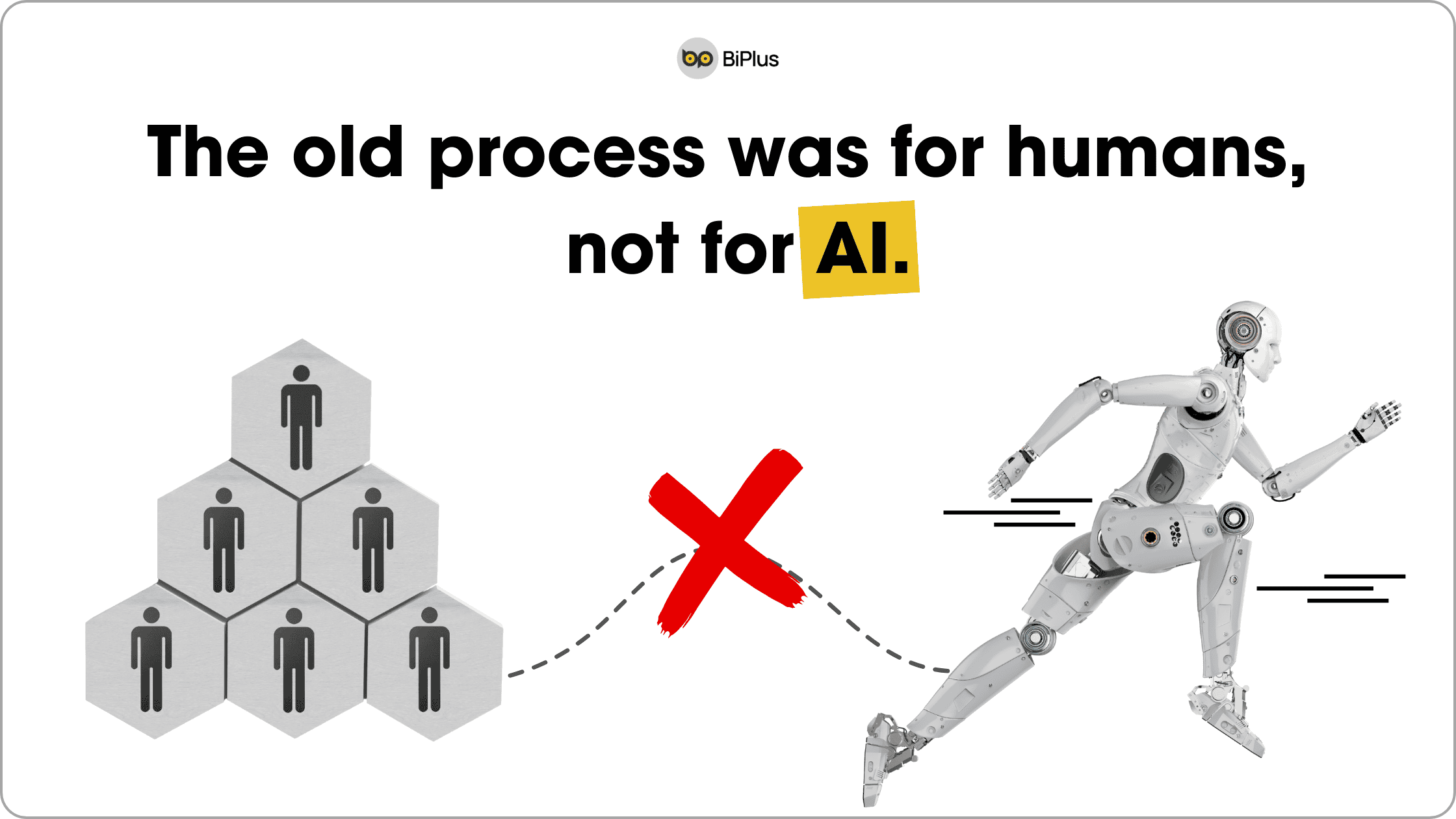
Most organizations approach AI with familiar logic: keep existing workflows and add AI to make them faster. This mindset comes from traditional automation, where machines replace humans step by step based on fixed rules.
AI operates differently. According to Product School, the fundamental difference between traditional process automation and AI-driven automation is not speed, but context-aware decision-making under changing data. AI continuously infers, predicts, and adapts. It does not simply follow predefined scripts.
When AI is forced into workflows designed for humans, it becomes constrained by rigid steps. A seven-step approval process built fifteen years ago does not suddenly fit AI just because each step runs faster. AI may analyze data in seconds, but still waits days for human approvals designed around human cognitive limits. Over time, AI becomes just another complex layer on top of legacy processes, trusted by no one and relied on for nothing critical.
The Core Problem: Processes Were Designed for Humans, Not AI
Most enterprise workflows are built around humans: humans make decisions, compile information, and transfer knowledge through meetings, emails, or messages. In such environments, AI is usually limited to supportive roles, summarizing, suggesting, or drafting, while the underlying decision structure remains unchanged.
However, AI creates real value only when it can:
- Participate directly in decision flows
- Access and connect knowledge across systems
- Receive feedback to learn and improve over time
A McKinsey (2025) survey shows that organizations reporting significant financial impact from AI are twice as likely to redesign end-to-end processes before selecting AI models. In other words, AI cannot be treated as a side tool, it must be recognized as a new operational layer.
AI Changes the Structure of Decisions, Not Just the Speed
A common oversight among leaders is assuming AI only accelerates existing work. In reality, AI reshapes decision cadence and structure. AI enables machine-speed decisions, pattern detection beyond human capability, and large-scale data synthesis. This leads to three structural shifts:
- Decision timing: AI can act in minutes, while workflows still assume days.
- Accountability boundaries: Responsibility blurs between model creators, users, and approvers.
- Control mechanisms: Step-by-step control no longer works; AI requires outcome-based control and feedback loops.
Without adapting the operating model, teams are left asking: "AI made the recommendation but who is ultimately responsible?"
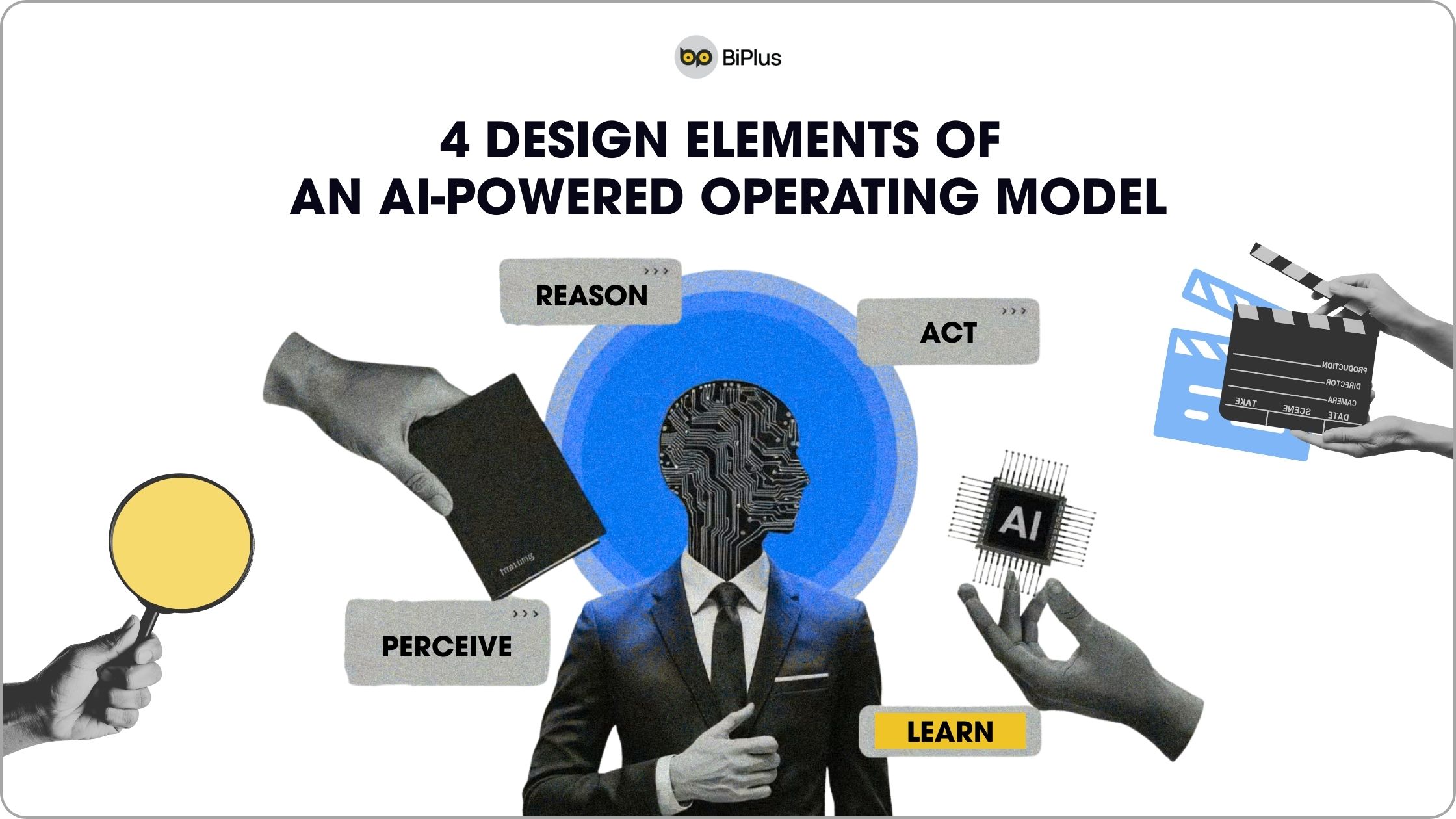
Four Design Principles for an AI-Enabled Operating Model
Instead of asking "Where do we add AI?", the better question is:
"Where does AI participate in how the organization operates?"
1. Which Layer Does AI Operate In?
AI may collect data, propose decisions, execute parts of workflows, or orchestrate across systems. Each choice requires different designs for responsibility, information flow, and risk management.
2. Clear Decision Boundaries Between AI and Humans
Not all decisions should be delegated to AI. Without explicit boundaries, AI remains stuck in a recommendation-only role that no one fully acts upon.
3. Redesign Knowledge Storage and Sharing
AI depends on structured, accessible knowledge. An AIIM (2024) survey found that 77% of organizations rate their data quality and AI readiness as average or poor. When knowledge lives in individuals' heads, AI lacks the context needed to produce reliable outcomes.
4. Define Feedback Loops for AI
AI cannot improve without feedback. Operating models must define which signals retrain systems, who reviews outputs, and how adjustments occur over time.
System of Work: The Foundation for AI to Function
When positioned correctly, System of Work becomes the organizing philosophy for how work happens, not a tool, but a structure. Atlassian's collections, from Teamwork Collection (Jira, Confluence, Loom, Rovo) to Service Management Collection, address different organizational contexts but share the same principle: work must be visible, knowledge captured, and collaboration continuous.
Teamwork Collection (Jira, Confluence, Loom, Rovo) is often the natural starting point, as it hosts daily workflows, planning, execution, iteration, and review. When these platforms connect into a unified system, they create organizational visibility across teams. This is the operational backbone of a System of Work and where AI begins to matter. AI outside these systems lacks context. Integrated into them, AI can understand relationships between work, people, and information, allowing the System of Work to evolve, not just operate.
A Practical Perspective for Team Leads and PMs
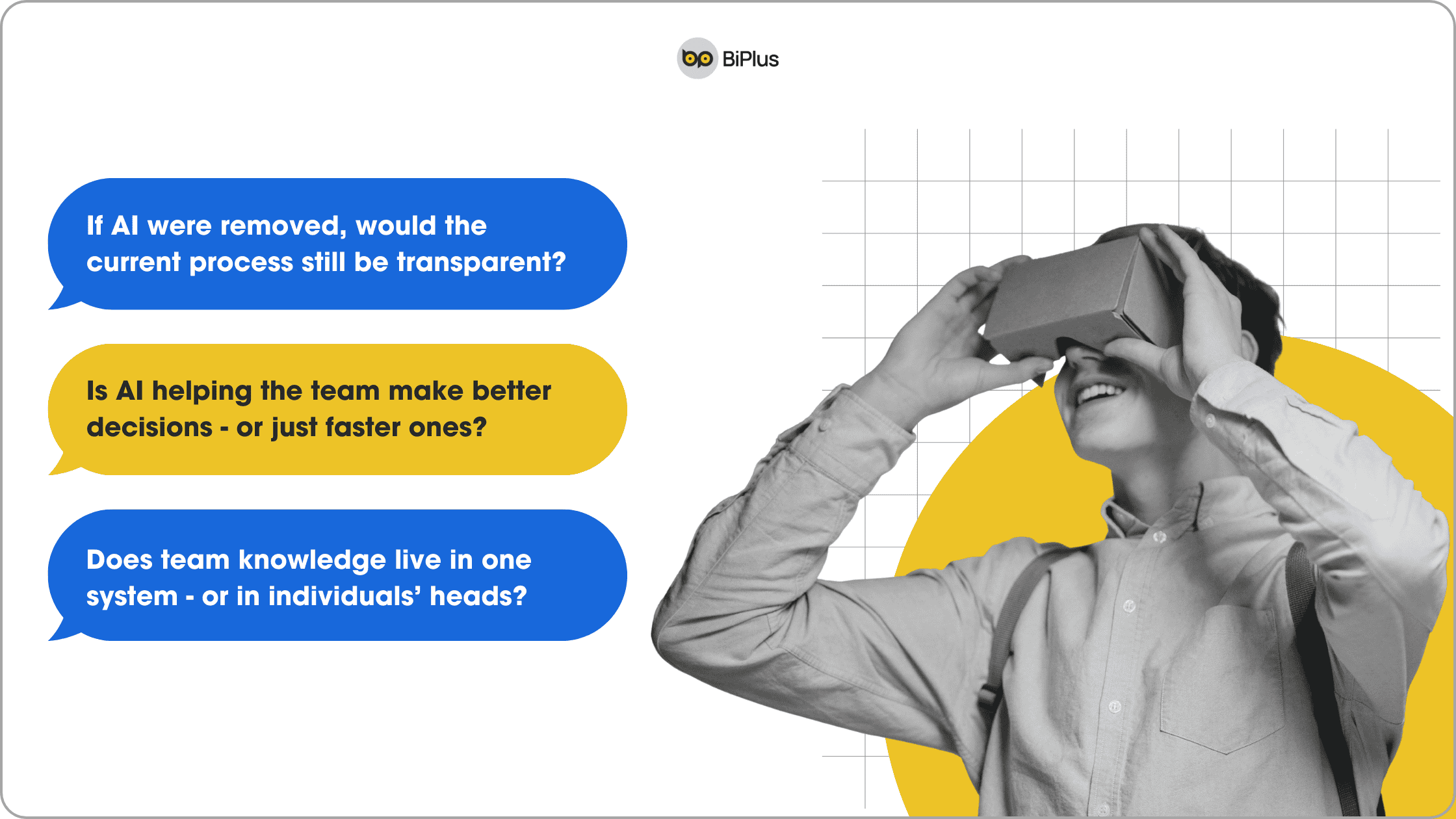
If you are considering AI for your team, start with three grounded questions:
If AI were removed, would the current process still be clear and transparent?
If not, AI will amplify confusion. Informatica (2025) identifies poor data readiness, technical immaturity, and skill gaps as leading barriers to AI success.
Is AI helping the team make better decisions or just faster ones?
Speed without quality increases risk. Successful organizations spend 50 - 70% of AI budgets on data preparation and governance.
Does team knowledge live in one system or in individuals' heads?
AI is only effective when knowledge is documented, retrievable, and reusable.
Conclusion: Don't Just Add AI - Redesign How Work Happens
AI failure rates of 70 - 85% are not caused by weak technology, but by flawed implementation. AI is not a new coat of paint on old processes. It requires a connected System of Work where tasks, knowledge, and data flow together. Teams that succeed with AI are not those using the latest tools, but those that redesign their operating systems, defining roles, accountability, and feedback before deploying AI.
From BiPlus's experience working with organizations in Vietnam, successful teams always start with System of Work. They ask not "Which AI should we use?" but "Is our system ready for AI to participate?"
The real question is no longer whether your organization uses AI but what kind of System of Work AI is designed to serve.