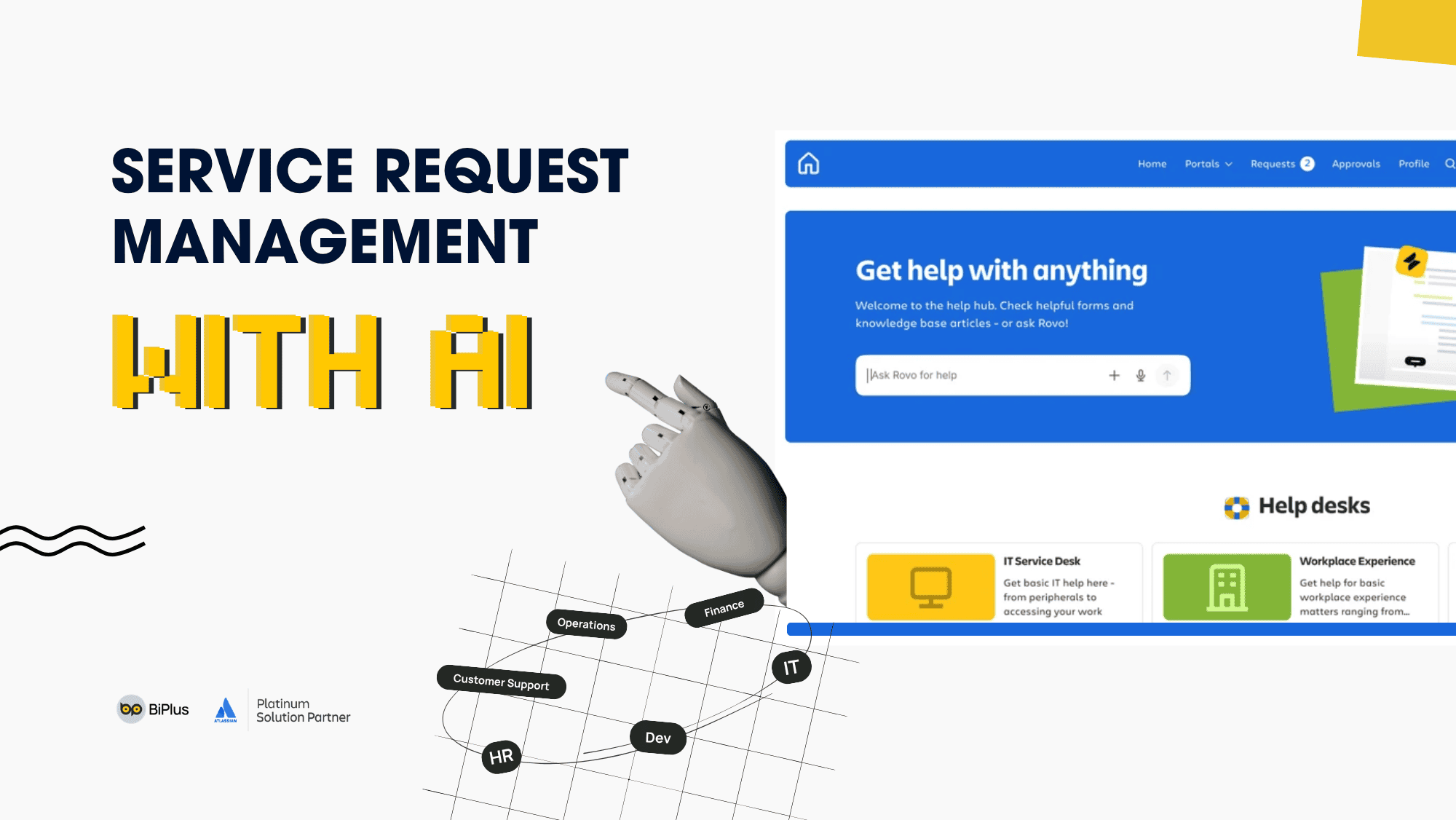
When IT Teams Live in Chaos
In the digital era, the IT department is often regarded as the backbone of the enterprise. However, in reality, many organizations - especially in the Finance, Banking, and Insurance (BFSI) sectors - face an alarming situation: the chaos of service requests.
When tickets flood in from every direction - Zalo, personal emails, or direct phone calls - IT teams fall into a state of constant "firefighting." The consequences are clear: approval delays, unstandardized input data, and rising user dissatisfaction. How can you transform the support journey from a nightmare into a 5-star experience? The answer lies in restructuring Service Request Management through standardization and the power of AI.
Bottlenecks in Traditional IT Operations
Why do talented IT teams still find themselves frequently overwhelmed? Through our consulting experience with large enterprises, BiPlus has identified three main bottlenecks:
Fragmented Intake Channels: The lack of a Single Point of Contact (SPOC) leads to lost information and makes tracking progress nearly impossible.
Unstandardized Input Data: Users submit requests missing critical information, forcing IT staff to engage in time-consuming back-and-forth communication (which can account for up to 30% of processing time).
Manual Approval Processes: Requests requiring management sign-off often get stuck in paper-based workflows or buried in email threads.
To solve these issues at the root, businesses need a modern approach where technology leads the way.
Detailed Solution: Optimizing the Support Journey with Process and Technology
BiPlus proposes a management model that focuses on resolving these bottlenecks by combining standardized processes with intelligent automation features.
Centralized Portal: Building an IT "Service Supermarket"
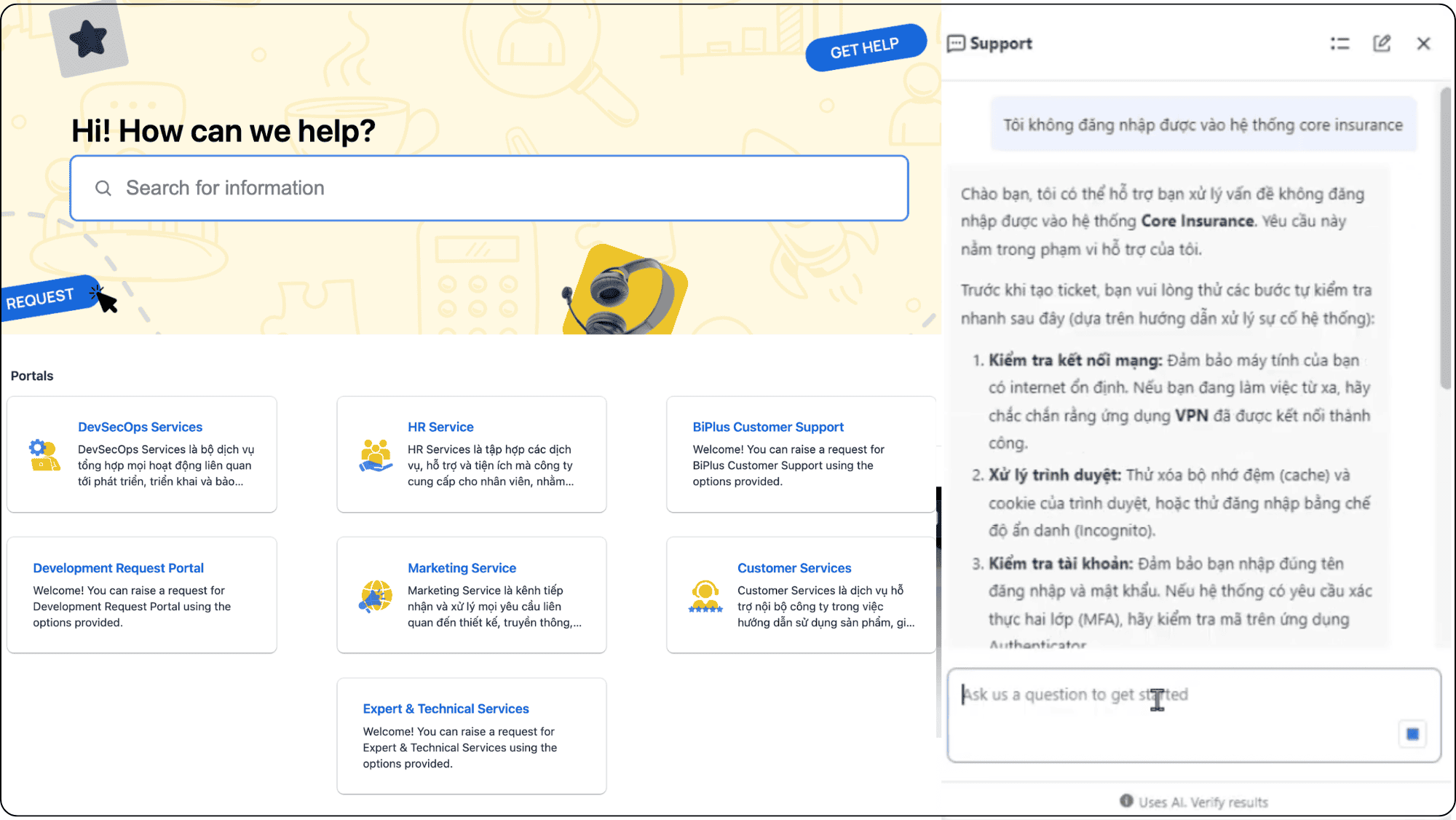
Instead of requiring users to remember dozens of email addresses or phone numbers for different departments, a centralized portal serves as a Single Point of Contact.
The portal interface is designed to be intuitive, clearly categorizing service groups such as Hardware Support, Software Access, Infrastructure Services, or Account Requests. Even without deep technical knowledge, users can easily find what they need through illustrative icons and a smart search bar.
Furthermore, as users type keywords, AI-powered analysis identifies their intent to suggest the exact service or relevant Knowledge Base articles. This enables Self-service, allowing users to resolve simple issues independently without creating a ticket, providing immediate relief for the support team.
Dynamic Forms: Capturing Clean Data from the Start
This is the most critical tool for reducing IT workload. A common mistake in legacy systems is using a single static form for all request types, leading to incomplete or incorrect data.
Smart forms utilize flexible display logic: subsequent fields only appear based on the user's previous selections. For example, if an employee selects "Software Access," the system displays a list of authorized software. If they choose a specialized system like "Core Insurance," the form automatically requires an attachment of their current permission screenshot and a business justification.
This approach ensures that by the time a ticket reaches an IT agent, it contains 100% of the data needed for immediate processing, eliminating the "ping-pong" communication that typically drains Service Desk productivity.
Automated Approval and Routing
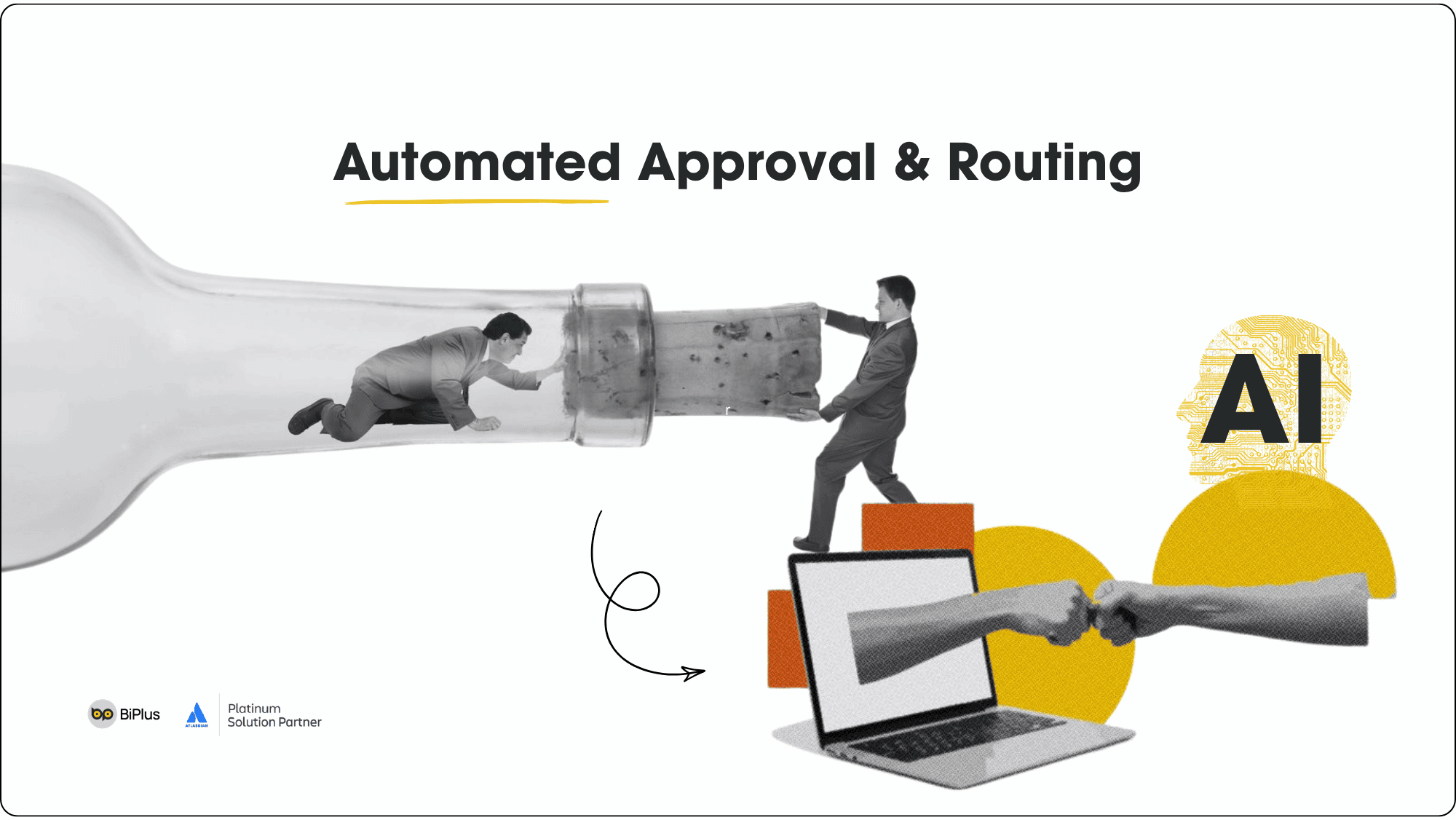
The biggest bottleneck in request management often occurs while waiting for approvals from direct managers or department heads.
Modern solutions like Jira Service Management allow for automated identification of approvers based on the organizational structure. As soon as a ticket is submitted, an approval notification is sent instantly to the manager's mobile device or email. Once approved, automation takes over the routing: based on the request type and the IT staff's skill set, the ticket is transferred to the right expert in seconds without manual intervention from a team lead.
Flexible Access and Smart Alerts
In the era of flexible work, limiting support to the internal network is a major barrier for field staff or mobile executives.
The solution is perfectly optimized for mobile devices, allowing users to submit requests and track progress anytime, anywhere. Here, AI capabilities can be applied to analyze similar past tickets, suggesting the most optimal resolution paths for IT staff. Users also receive automated progress alerts, keeping them informed without needing to call and nudge the IT department.
Case Study: Standardizing Service Requests for an Insurance Enterprise
To demonstrate effectiveness, let's look at a project BiPlus implemented for a leading insurance firm within a major financial group in Vietnam.
Context: The enterprise faced a fragmented service catalog, unclear Service Owners, and a lack of Service Level Agreements (SLAs). This resulted in ticket backlogs and high user dissatisfaction.
BiPlus Solution:
Restructured Service Catalog: Redefined the entire catalog using business language familiar to users.
Specialized Form Design: Applied Dynamic Forms for complex requests related to core systems and asset management.
SLA and Automation Setup: Established specific time commitments and automated approval workflows for 5 core process groups.
Results:
Response Time: Reduced from 4 hours to under 30 minutes.
Overdue Ticket Rate: Dropped by 45% within the first quarter of operation.
Customer Satisfaction (CSAT): Reached 4.8/5, significantly improving the relationship between IT and business departments.
See full case study
Advice for IT Managers: Simplify to Effectuate
Service Request Management is not just about installing software; it is about redesigning an experience journey. My advice to IT Managers is: Design the Portal from the user's perspective, but design the Forms from the IT staff's perspective.
When you make submitting a request easy, users will follow the process. When you leverage the power of automation to clean input data, your IT team will work at peak efficiency instead of being exhausted by trivial tasks.
FAQ: Optimizing Service Requests
Q1: How do we encourage users to use the Portal instead of calling or messaging directly?
Answer: Apply the "Portal First" principle. Every request coming through other channels should be met with a response containing a link to the specific service on the Portal. Once users see that Portal submissions are handled faster and more transparently, they will naturally change their habits.
Q2: Is automation difficult to set up and maintain?
Answer: With modern platforms like Jira Service Management, setup is entirely "No-code." You can easily drag and drop rules without needing a programmer, allowing the business to remain flexible as needs change.
Q3: What is the most important role of AI in request management?
Answer: AI is most effective as a "virtual assistant" at both ends: helping users find answers faster via the Portal (Self-service) and helping IT staff categorize and suggest solutions based on historical data using tools like Atlassian Rovo.
Q4: How do we accurately measure the effectiveness of the Service Request process?
Answer: Focus on three key metrics: First Response Time, Request Fulfillment Time, and CSAT (Customer Satisfaction Score).
Are you ready to free your IT team from the ticket storm?
Don't let manual processes hold back your business growth. Contact BiPlus for a consultation on your ITSM standardization roadmap and experience a solution tailored to your specific needs.
Connect with a BiPlus Expert Today!