Modern PMO (VMO) is a next-generation project portfolio governance model driven by real-time data and AI. Explore the 4-pillar framework, 2 real-world use cases, and the transformation roadmap from BiPlus.
BiPlus is a consulting and implementation partner for portfolio governance and technology process optimization for large enterprises in Vietnam across Banking, Financial Services, Insurance, and Securities.
As a specialized Atlassian partner, BiPlus provides end-to-end transformation solutions from traditional PMO to Modern PMO (AI-Powered VMO) on Jira, Jira Plans, JSM, and Atlassian Rovo AI - helping reduce manual reporting time by over 80% and connecting strategic objectives down to technical backlogs.
Why Are Traditional PMOs Trapped in Operational Bottlenecks?
How much time does your PMO spend asking teams for status updates?
In many large enterprises where BiPlus consults directly, that number is 60-70%. PMOs spend their days sending emails, messaging PMs and Tech Leads for updates, and manually copying data from Excel into PowerPoint presentations for the Board of Directors- using data that is already 1 to 2 weeks old. Meanwhile, three urgent questions remain unanswered:
How do we connect C-Level strategic goals down to technical backlogs?
How can we forecast resource overload and cross-team dependencies before projects run late?
When data is scattered across Jira, Confluence, email, Google Drive, and SharePoint, how can AI resolve context while maintaining enterprise security?
This article moves from current operational challenges to a comprehensive solution framework. It is based on BiPlus's practical deployment experience across large enterprises in Vietnam, particularly in banking, financial services, insurance, and securities.
Four Operational Traps Holding Traditional PMOs Back
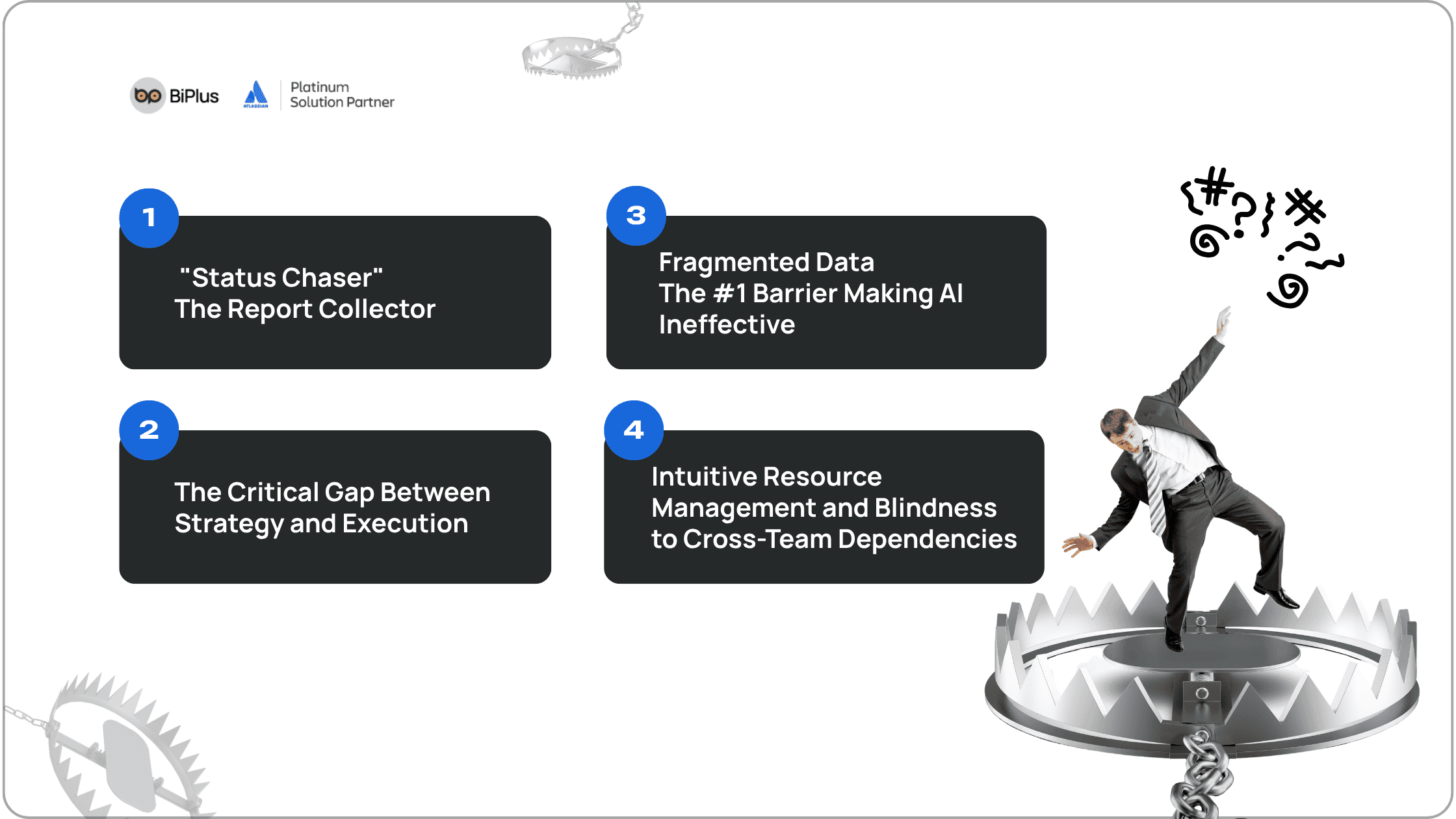
Trap 1: "Status Chaser" - The Report Collector
This is the most common trap. The PMO becomes a reporting hub: collecting disconnected data from PMs, pasting it into templates, and presenting it to leadership. By the time reports reach C-level executives, the information has been subjectively filtered, hiding risks until the schedule breaks. The PMO loses its seat at the strategy table and is labeled as an administrative function.
Trap 2: The Critical Gap Between Strategy and Execution
Leadership looks at corporate OKRs; technical teams look at User Stories in Jira. There is no real-time data bridge between these two layers. Many organizations have invested in Jira and Confluence for hundreds or thousands of users, but only use them for task assignment within isolated squads. Without a multi-tier hierarchy and automated roll-up mechanisms from Sub-task to Epic, and from Epic to Software Request and Goal, PMOs still compile reports manually despite having data in the system.
Trap 3: Fragmented Data - The #1 Barrier Making AI Ineffective
Project requests live in emails and chats, plans sit in Excel or legacy Redmine systems, documents reside in SharePoint, and source code is stored in Git. If you introduce AI into chaotic data and unstandardized processes, it simply produces inaccurate reports faster.
In BiPlus's engagements, 70-80% of Modern PMO success comes from the initial foundation: cleaning up redundant fields, standardizing SDLC workflows, and establishing a single source of truth before activating any AI agent.
Trap 4: Intuitive Resource Management and Blindness to Cross-Team Dependencies
In complex systems such as Core Banking or Microservices architectures, over 80% of go-live delays stem from cross-team dependencies - for example, the Mobile team finishes development, but the Core team's API is not ready - not from a single team's capability. PMOs often discover these bottlenecks right before the deadline. Without quarterly capacity data, staffing allocations rely on intuition. This leaves key individuals overloaded at 150-200% capacity while overall delivery remains blocked.
According to the Atlassian State of Teams 2025 report: 76% of employees work on tasks outside core priorities, only 13% of leaders are confident they have full visibility, and 50% of work is duplicated across departments. This is not a tooling problem. It is a system architecture problem.
What is a Modern PMO and How Does It Differ from a Traditional PMO?
A Modern PMO is a next-generation project portfolio governance model. In this model, the PMO shifts from being a "process enforcer and report collector" to a strategic partner for the Executive Board, powered by real-time data and AI.
Instead of measuring task output, the Modern PMO measures realized business value.
Instead of enforcing rigid processes, it listens to internal stakeholders - Division Heads, PMs, Tech Leads, project members - and provides matching services.
Instead of acting as a cost center, the Modern PMO proves its value through quantifiable business outcomes.
Comparison Table: Traditional PMO vs. Modern PMO vs. Transform PMO (AI-Powered VMO)
| Comparison Criteria |
Traditional PMO |
Modern PMO |
Transform PMO / AI VMO |
| Primary Role |
Collecting reports, enforcing processes |
Portfolio governance, value optimization |
Strategic executive partner, driving business value |
| Reporting Time |
2–3 man-days/week (manual) |
Partially automated on Jira/Plans |
1 minute to review (AI pre-drafted, >80% reduction) |
| Report Data Latency |
1–2 weeks lag |
Updated daily/hourly |
Real-time (two-way automated sync) |
| Request Approval Time |
2–4 weeks via paper/email |
1–2 weeks via digital portal |
A few days (automated scoring & routing) |
| Resource Management |
Intuitive, assumes 100% availability |
Measures realistic Capacity, 4B model |
Forecasts load 3 quarters ahead with what-if scenarios |
| Cross-Team Dependencies |
Discovered near deadline |
Visual dependency map on Jira Plans |
Early warnings 2–4 weeks before bottlenecks break |
| AI Adoption |
None or fragmented AI use |
Standardized data ready for AI |
AI Agents propose - Humans decide |
The 4-Pillar Framework: Align - Optimize - Predict - Enable
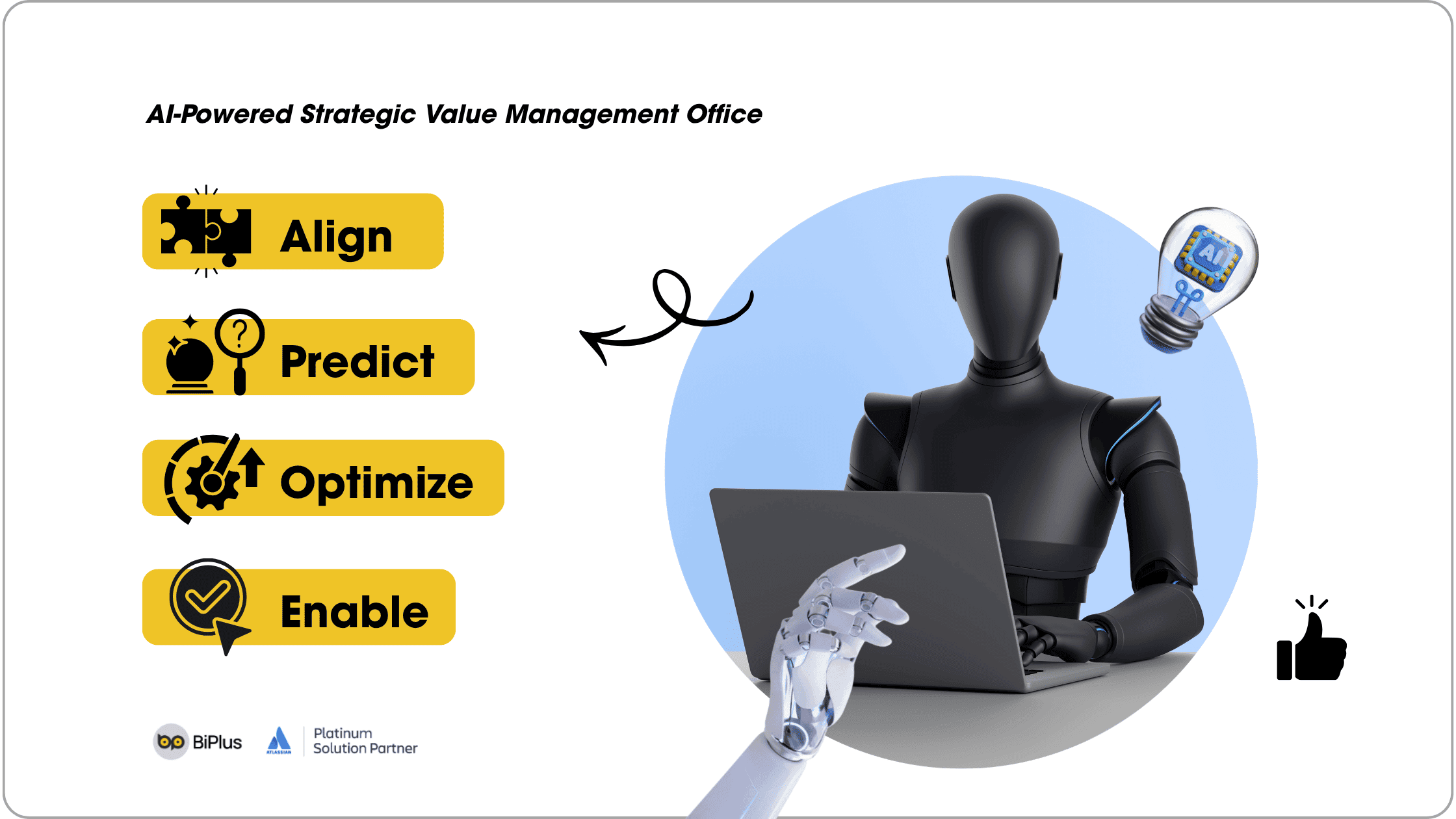
Align: Connecting Strategy to Portfolio and Execution
A modern PMO must help the organization clearly answer key questions: Which project serves which strategic goal? What is its priority level? Where are resources being invested? Is the expected value tracked end-to-end? When strategy, portfolio, and daily execution connect on a single data platform, decision-making is no longer based on intuition or delayed reports.
Within the system, this connection is realized through a single intake portal on JSM. It features automated scoring across 5 pillars: Strategy, Value, Urgency, Complexity, and Cost and routes approvals under clear SLAs. Atlassian Goals and Jira Plans centrally manage goals and portfolios, linking directly down to each Epic and Story. Rovo AI recommends data-backed priorities, while humans remain the final decision-makers.
Predict: Spotting Risks and Dependencies Before It Is Too Late
Instead of merely recording issues after a project falls behind, the PMO can move toward a predictive governance model. This provides early warnings when resources are overloaded, cross-project dependencies are at risk of breaking, timelines deviate from the plan, or data quality is insufficient for decision-making. When placed on a reliable data foundation, AI becomes a support layer that shifts the PMO from reactive to proactive.
In Jira Plans, visual dependency mapping provides early warnings 2-4 weeks in advance when one team's delay impacts a chain of other teams. A Rovo Agent scans Jira data weekly, analyzes blocked Stories, reviews overdue Tasks, and drafts a Project Health Report - requiring the PMO only to confirm or reject. After meetings recorded via Loom, the Agent automatically extracts Action Items, assigns owners, and creates corresponding Jira tickets.
Optimize: Optimizing Resources, Processes, and Portfolio Value
At the scale of hundreds of project members, optimization is not just about moving faster - it is about investing smarter: prioritizing the right initiatives, allocating the right capabilities, standardizing stage gates, improving decision quality, and giving PMOs time back to focus on analysis, advisory, and value leadership.
The system calculates realistic Capacity based on working hours minus leave, maintenance overhead, and average Velocity. This helps the PMO answer quantitatively: "Can we take on 3 new projects next quarter?" The 4B resource strategy expands delivery options: Build, Buy, Borrow, Bot. EVM-lite automatically calculates earned value based on actual logged hours and completion progress, enabling real-time budget control instead of waiting for end-of-period reconciliation.
Enable: Making AI a Daily Way of Working
The final pillar focuses on organizational capability: establishing approved AI toolsets, defining agent profiles with designated owners, and delivering two-way training programs for both AI oversight and AI usage.
Three core principles govern this pillar:
Single Source of Truth: AI can only process well-structured data.
Human-in-the-Loop: AI provides recommendations with supporting evidence; human decision-makers approve under their name.
Closed-Loop Learning: Actual outcomes feed back into the system to calibrate predictive models, improving accuracy over time.
Two Real-World AI-Powered PMO Use Cases
Use Case 1: PMO Status Reporter - Automated Project Health Reporting
Pain Point: A PMO Director at a commercial bank manages over 40 IT projects simultaneously. Each week, the PMO team spends 2-3 man-days emailing PMs for updates, compiling data in Excel, and building PowerPoint decks for leadership. By the time reports reach C-level executives, the data is at least 1 week old and often smoothed over - masking real risks until delivery fails.
Solution: A Rovo Agent automatically scans Jira data for every project every Monday, analyzing blocked Stories, overdue Tasks, and at-risk cross-team dependencies. The Agent drafts a standardized Project Health Brief. The PMO reviews the brief, adds qualitative context, and confirms distribution. Reporting compilation time drops by over 80%, and executives receive real-time data.
Use Case 2: Intake Scoring - Automated Scoring and Routing for Project Requests
Pain Point: Software development requests from business units arrive through emails, chat messages, and official dispatches without standardized forms or quantitative criteria. Project prioritization depends on "who speaks loudest" or subjective executive judgment. Multi-tier manual approval processes take 2-4 weeks before development teams can begin work.
Solution: BiPlus implements a single intake portal on JSM with an automated 5-pillar prioritization matrix. Upon submission, requests are scored and routed automatically: Fast-track for small requests meeting defined thresholds, or Full Gate for large projects requiring multi-tier approval -all managed within Jira workflows under defined SLAs. Approval time decreases from weeks to days, shifting decisions from intuition to data.
Contact BiPlus for Modern PMO details & 20+ live demo use cases
How to start your PMO Transformation?
Transitioning from a traditional PMO to a Strategic VMO is not just about buying AI tools. It is a transformation of governance mindset, data standardization, and operational culture.
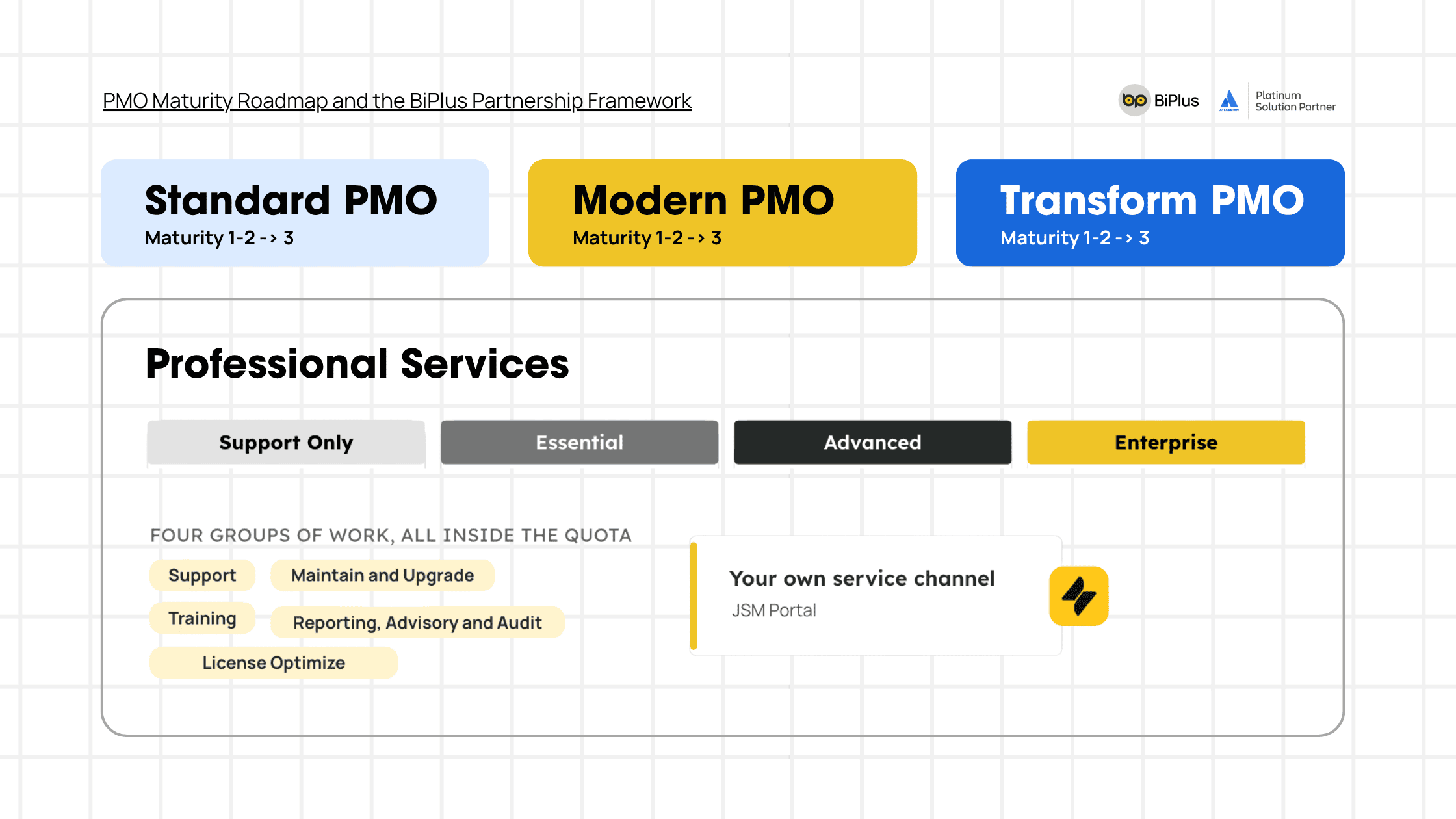
The first step is straightforward. BiPlus offers a complimentary PMO Maturity Assessment & Gap Analysis, which includes evaluating your current position on the maturity curve, identifying 2-3 quick wins for immediate deployment, and providing initial architectural guidance tailored to your organization.
Register for a 1-on-1 consultation or explore our Live Demo of 10 AI-Powered PMO Use Cases >> Contact BiPlus here.
Frequently Asked Questions (FAQ)
Q: How does a Modern PMO differ from a traditional PMO?
A: A Modern PMO shifts from manual status tracking and administrative enforcement to driving measurable business value through real-time data and AI. Instead of spending 60-70% of their time compiling delayed reports across spreadsheets, a Modern PMO leverages platforms like Jira Plans and Atlassian Rovo AI to automate over 80% of reporting effort while directly linking strategic OKRs to technical backlogs.
Q: Is it mandatory to buy new AI licenses to start deploying a Modern PMO?
A: No, organizations do not need AI licenses immediately. The foundational layers - including standardized intake portals on Jira Service Management (JSM), 5-pillar request scoring, and multi-tier hierarchy roll-ups in Jira Plans - rely entirely on core Atlassian configurations. Enterprises can begin with a 5-to-10 consulting man-day engagement with BiPlus to standardize their governance model before activating AI Agents.
Q: What is the most critical prerequisite before adopting AI in PMO operations?
A: Clean, structured data within a Single Source of Truth is the single most critical prerequisite. In BiPlus's enterprise implementations, 70-80% of Modern PMO success comes from standardizing SDLC workflows and cleaning custom fields across Jira and Confluence, ensuring that AI Agents process accurate context rather than amplifying disorganized data.
Q: How long does a Modern PMO implementation typically take?
A: A typical Modern PMO transformation takes 2 to 6 weeks for standardizing intake workflows and core portfolio structures. Moving to advanced stages - such as integrating custom AI Agents, automated risk forecasting, and cross-team dependency mapping - is generally completed within 8 to 12 weeks depending on organizational scale.