Many Organizations Already Have More AI Than They Think
When viewed from an organizational perspective, many companies possess far more AI assets than they consciously realize.
AI is no longer limited to standalone tools. Capabilities such as Gemini in Google Workspace, Copilot in Microsoft 365, ChatGPT Enterprise, and AI features embedded across SaaS platforms are already part of daily operations. At the team level, it is common to see internally built AI-based workflows, scripts, or lightweight automations that support routine work, from data processing and reporting to meeting preparation.
The core issue is not about availability. These capabilities exist, but they are scattered. In many organizations, they are not recognized as components of a shared AI landscape or managed as organizational assets.
For this reason, the more important question is no longer whether an organization has adopted AI. Instead, leaders should ask:
If you listed every tool, feature, workflow, and experiment involving AI in your organization, what would the big picture look like?
Of all these assets, which ones are actively driving results, and which are gathering dust or only exist on paper?
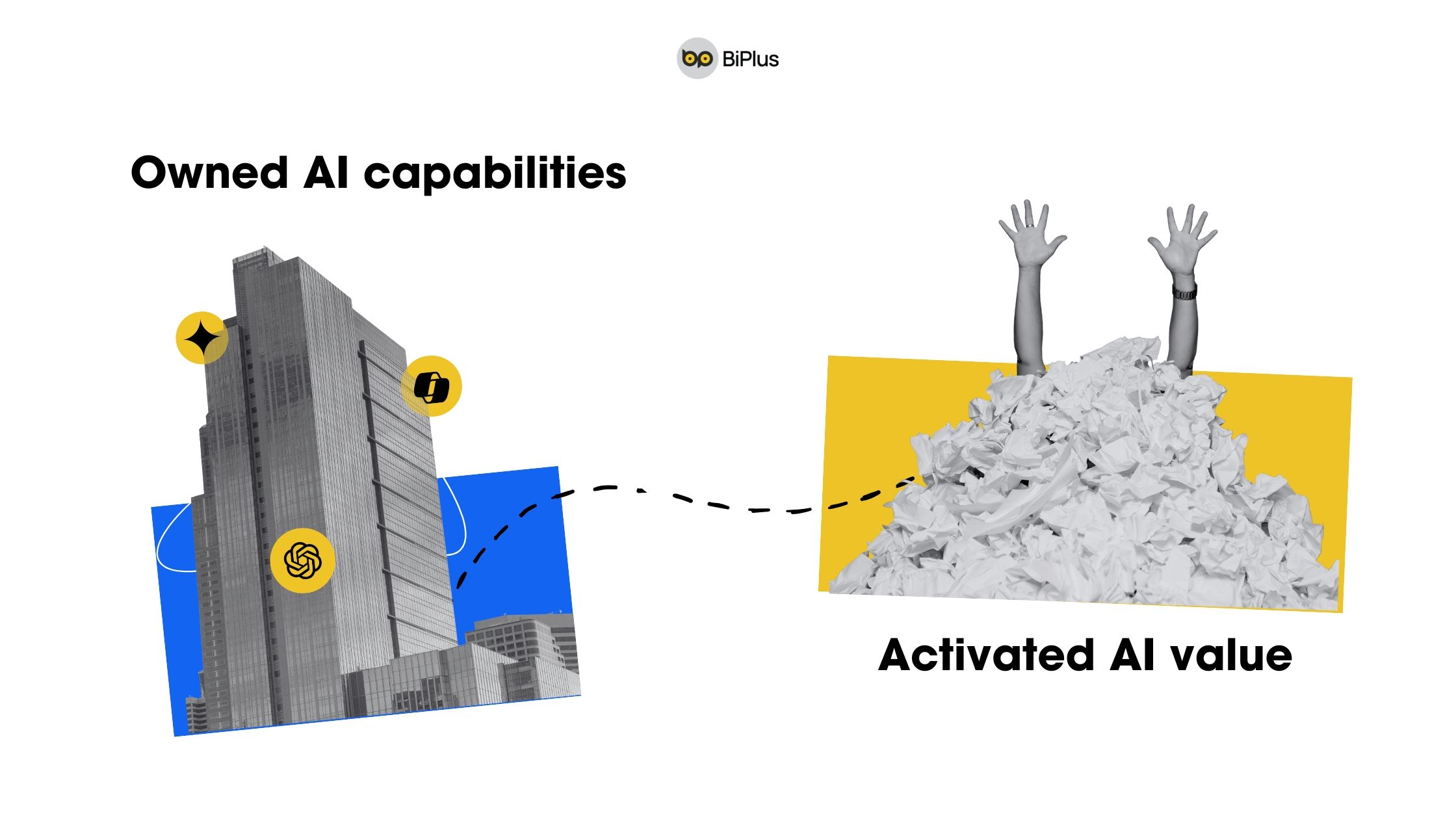
The gap between owned AI capabilities and activated AI value is where a structural issue begins to surface. This is known as the Hidden Value Crisis.
The Hidden Value Crisis is not caused by a lack of technology or delayed adoption. It is fundamentally a value problem. It emerges when AI capabilities already exist within the organization but remain latent. These assets are distributed across platforms, data sets, product features, and isolated experiments, without being viewed holistically, connected intentionally, or translated into measurable results.
For many CEOs, CFOs, Heads of Digital Transformation, and leaders responsible for AI initiatives, the Hidden Value Crisis explains a familiar situation. AI investments have been made. AI capabilities are already embedded in core systems. Yet when asked to articulate what value AI is creating for the business, and at what scale, the answers remain unclear or inconsistent.
What is the Hidden Value Crisis?
Many AI Assets, But Only the Tip of the Iceberg is Used
When you look at AI from an organizational asset perspective, most businesses today own more than they realize.
AI features that are already enabled or embedded in the platforms used daily
Data, documents, and knowledge bases that are sufficiently structured and clean for AI to leverage
PoCs, scripts, macros, workflows, or automations that teams have built to solve specific problems
The challenge is that most of these assets are not viewed as part of a bigger picture. They exist in silos, scattered across tools, departments, and isolated experiments.
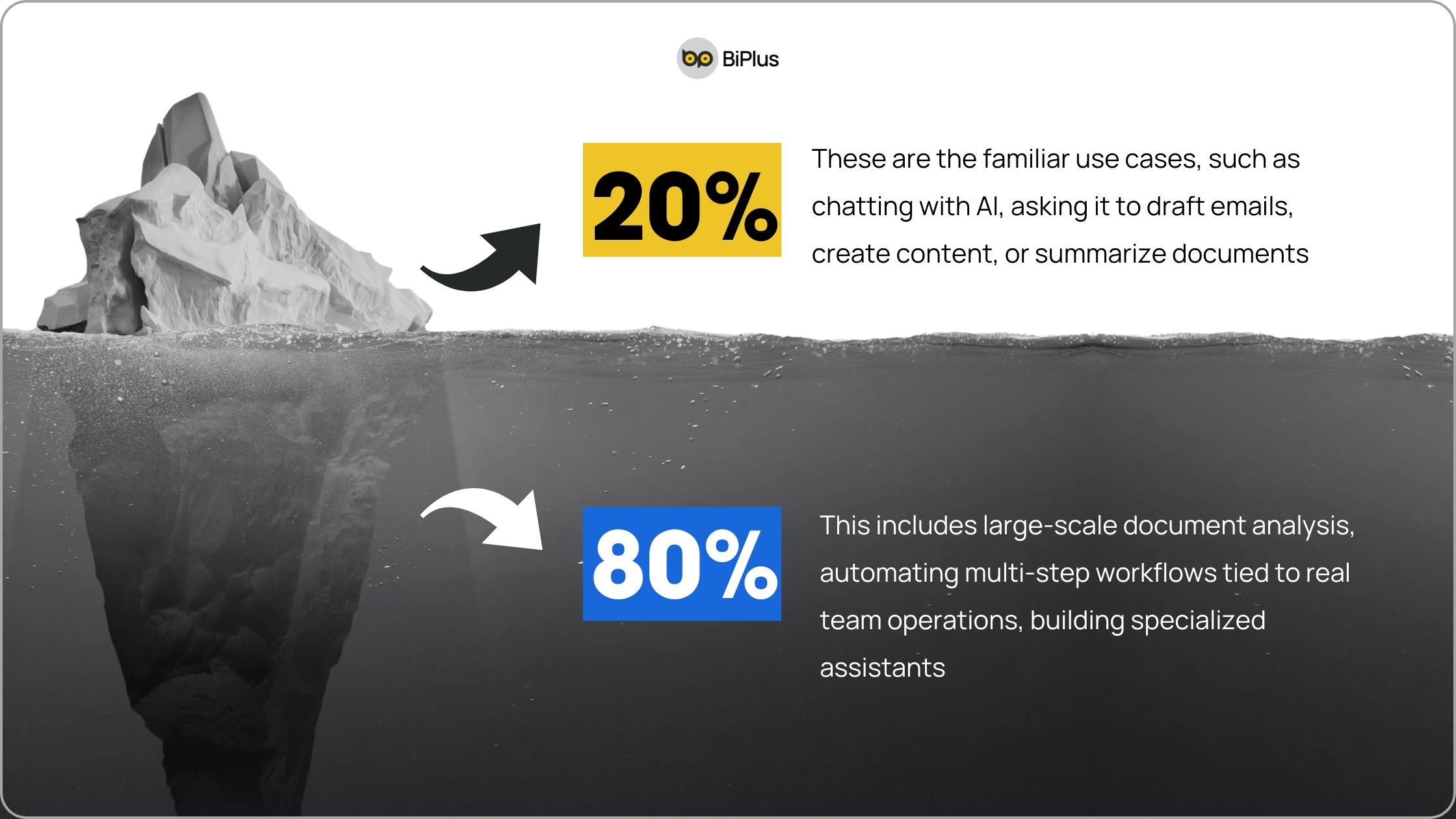
A useful analogy for this situation is an iceberg. The visible and frequently used part is just about 20%. These are the familiar use cases, such as chatting with AI, asking it to draft emails, create content, or summarize documents.
Meanwhile, 80% of the potential value lies beneath the surface, where very few people actually reach. This includes large-scale document analysis, automating multi-step workflows tied to real team operations, building specialized assistants for domains like IT, HR, Finance, or Operations, and small but highly tailored AI tools serving each department.
The Hidden Value Crisis appears when the gap between existing AI assets and actual usage becomes too wide. The greatest value of AI does not disappear; it is simply buried beneath the surface, out of sight and out of the daily workflow.
The Story of Capabilities That Have Existed for Years But No One Knows
This is a familiar story for many businesses in Vietnam and across APAC. Many organizations have purchased and used AI-enabled software packages for months or even years, but daily work habits remain unchanged. A typical example is Microsoft 365 with Copilot. Companies pay for this AI capability, but most employees still use Word, Excel, or Outlook in the traditional way.
Few realize that Copilot can automate recurring reports, analyze data directly within familiar tools, or help prepare meeting content based on existing emails, documents, and calendars.
A similar situation occurs with companies using the Atlassian ecosystem. Rovo is an enterprise AI platform deeply integrated with Jira and Confluence, but in reality, most users only perform basic actions like creating tickets or writing documentation. Few realize that Rovo can automate testing, analyze bugs, or directly participate in workflows to review document quality, summarize project progress, and suggest improvements.

In BiPlus's practical workshops, when teams are guided to use Rovo for bug report checks, PRD evaluations, or DACI framework analysis, the most common reaction is surprise. This is not because the features are new, but because these capabilities have always existed in the system and have not been put into practice.
AI assets with the potential to create significant value have been there all along, but that value remains dormant because no one has proactively reviewed, connected, and integrated them into daily work.
This shows that the essence of the Hidden Value Crisis is not a lack of technology or new tools. The real issue is that many advanced features already included in your subscriptions are not purposefully leveraged, so value exists but never becomes tangible results.
Signs Your Organization is Facing a Hidden Value Crisis

AI Usage Stops at Personal Convenience
One of the most obvious signs of a Hidden Value Crisis is when AI is used only as a personal productivity tool, rather than becoming part of the organization's operational capability.
In practice, AI is often used to draft emails, write captions, quickly translate content, or summarize documents. These uses bring immediate convenience, but the value created is small, fragmented, and difficult to measure at the organizational level.
More importantly, AI is rarely embedded directly into core team processes such as weekly reporting, handling internal requests, meeting preparation, or analyzing customer feedback. AI exists alongside work, but not truly within the workflow.
A practical way to check is to review your current processes and ask how many of them are delivering measurable results thanks to AI. If it is hard to answer with specific numbers, such as how much processing time has been reduced or how much output quality has improved, it is a clear sign that AI is still just a personal convenience and not an operational capability.
Teams Are Frequently Surprised by Existing Features
Another clear sign is the collective surprise whenever an AI feature is mentioned.
Organizations realize they have paid for these capabilities, the features have been in the system for a long time, but they have never been put into real use. This surprise does not come from new technology, but from value that has always existed but has not been seen.
When this happens across multiple teams, the Hidden Value Crisis is no longer just a personal or technical issue. It becomes an organizational one. The value is there, but no one is responsible for turning it into results.
Why Does the Hidden Value Crisis Matter?
It Directly Impacts How Leadership Evaluates AI Efforts
From a leadership perspective, AI is often evaluated by the budget spent and the time teams invest in AI-related activities.
However, when the core question is asked about concrete results over the past six to twelve months, the answers are often inconsistent and hard to back up with data. This is not because AI has not created value, but because some value has been generated but never measured or recorded, and a large portion still lies beneath the surface, never activated in operations.
When value is not visible, AI is easily judged as ineffective or lacking impact, even when the real potential is much greater.
Too Much Hidden Value Makes Every Next Decision Harder
The Hidden Value Crisis does not just affect how you look at the past. It directly paralyzes future decisions.
When organizations cannot clearly see their current AI asset landscape, strategic questions like where to invest next, what capabilities to buy, and what value just needs to be unlocked become very difficult to answer. Building an AI strategy or AI-Native roadmap then lacks a data-driven foundation and easily becomes guesswork.
Practical Steps to Address the Hidden Value Crisis
Start by Asking About Under-the-Radar AI Assets
The first step to addressing the Hidden Value Crisis is not buying more technology. It is reviewing what your organization already owns.
Start by auditing major platforms like Google, Microsoft, Atlassian, CRM, or ITSM to see which AI features are enabled. At the same time, revisit PoCs, agents, or internal workflows that were built but never fully utilized.
Simply answering these questions will help clarify your AI asset landscape.
Encourage Small Discoveries Over Big Projects
The Hidden Value Crisis does not have to be solved with a large-scale project. Small, consistent discoveries often bring more sustainable results.
Each week, each team can pick one tool or AI feature they are using, spend time exploring untapped capabilities, and share one or two useful findings in a short meeting. These small actions gradually reveal more of the iceberg and help teams realize they already have more AI capability than they thought.
In the Long Run, It's About AI Governance
Addressing the Hidden Value Crisis is not just about technology. It is closely tied to how your organization governs AI. It is about roles and responsibilities, sharing and standardizing effective AI practices, and moving AI from personal experiments to organizational capabilities.
This is also the core of BiPlus's AI-Native programs and AI transformation services. We do not just talk about what AI can do. We help businesses see the hidden value in their existing AI assets and turn that value into measurable results in daily work.
BiPlus and the Hidden Value Crisis
BiPlus approaches the Hidden Value Crisis with our Audit, Activate, Optimize, and Centralize framework. This approach helps organizations clarify, activate, and operationalize AI value step by step.
Audit means assessing all existing AI assets across the organization.
Activate is about identifying and unlocking underutilized AI value.
Optimize focuses on refining proven AI use cases for greater impact.
Centralize means standardizing and scaling successful practices into organizational capabilities.
If you feel your organization has many AI assets but are not sure how much value you are actually unlocking, this could be a sign of the Hidden Value Crisis. The first step is not buying new tools or launching big projects. It is systematically reviewing what you already have and how it is being used. This is also the starting point for BiPlus's strategic consulting and AI-Native transformation roadmap services.
Beyond strategy and roadmaps, the Hidden Value Crisis reveals a deeper gap in how teams understand and work with AI. Much value remains buried not due to a lack of technology, but because there is no shared method to identify, assess, and consistently integrate AI into daily work.
That is why BiPlus's AI-Native training programs do not just teach tools or isolated features. The focus is on helping organizations shape methodologies, build shared frameworks, and create a unified language around AI. Teams do not just know what AI can do. They learn to ask the right questions, spot value opportunities, and integrate AI into workflows in a controlled and effective way.
These programs are tailored to each organization's context and roles, from leadership and management to operational teams. The goal is not more isolated experiments, but empowering teams to proactively discover, activate, and sustain value from AI assets already in place.
👉 Curious about where your organization stands on the journey to unlocking AI value?
Contact BiPlus for expert guidance and partnership on your effective AI-Native transformation.