AI is becoming a familiar line item in many corporate investment plans. Infrastructure is being upgraded, new tools are introduced at a rapid pace, technical teams are growing stronger, and PoC projects are multiplying. From the outside, it may look like organizations are moving fast on their AI journey.
Yet when we look more closely at real world implementation, an uncomfortable question begins to surface: Why does AI, despite significant investment, still struggle to deliver clear and measurable value for operations and business outcomes?
The Gap Between AI Investment and Real Results
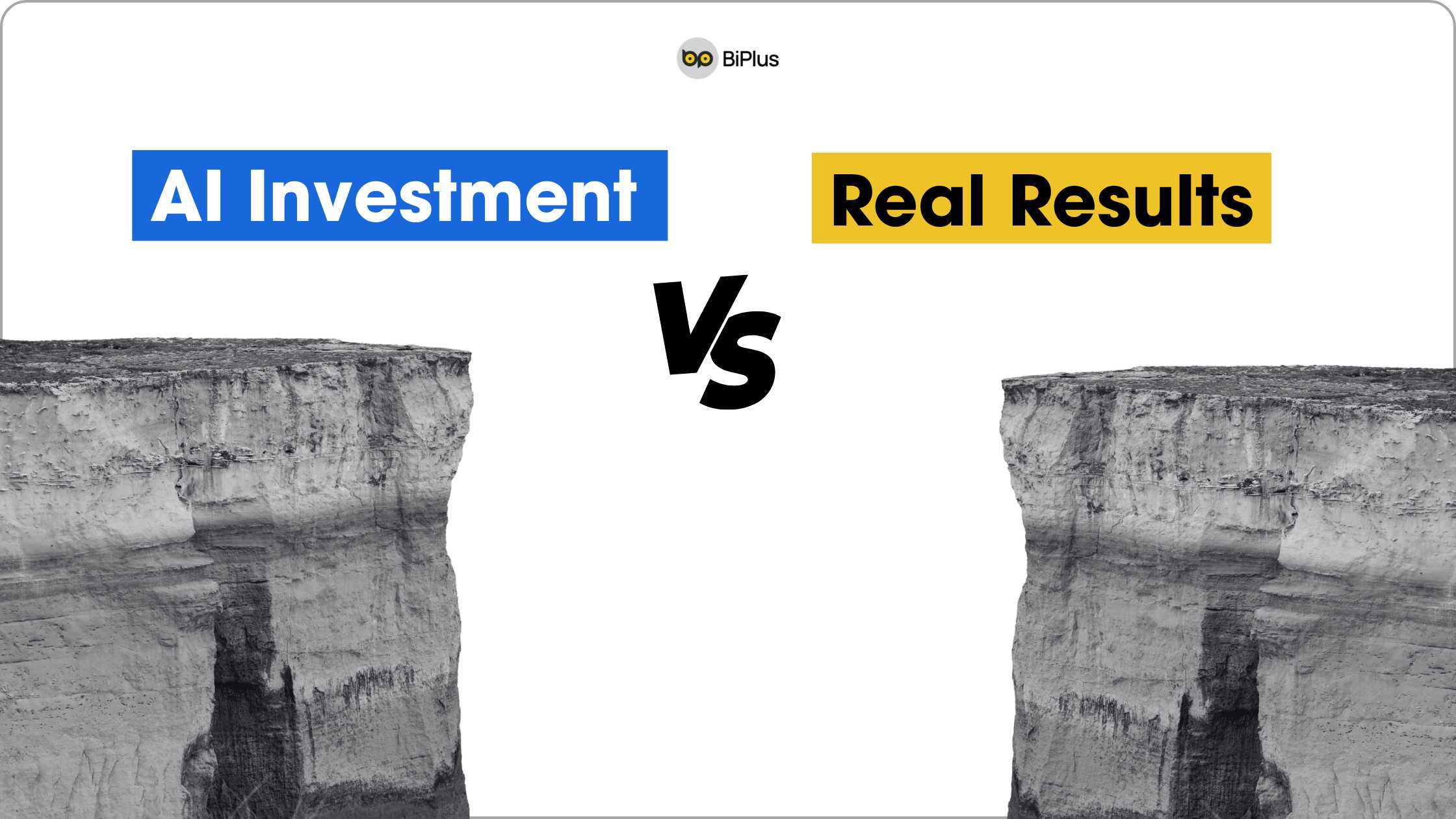
Many organizations find themselves in a similar situation. They invest in AI infrastructure, purchase additional licenses, hire talented AI engineers and data scientists, and build impressive PoC initiatives. But when CEOs or CFOs ask how much revenue AI has generated, how much cost it has reduced, or how much risk it has mitigated, the room often falls silent.
This is not a failure of algorithms or engineering teams. The root cause lies elsewhere. Organizations tend to invest heavily in AI technology capabilities while failing to build business capabilities powered by AI. Technology moves fast, but organizational structures, processes, decision making models, and value measurement remain largely unchanged. As a result, AI appears in slides, demos, and internal reports, yet never becomes a true operational capability.
Global studies consistently show that while enterprises may experiment with dozens or even hundreds of AI use cases, only a small fraction achieve clearly measured ROI and scale across the organization. Tools, models, and platforms are abundant. What is scarce is the ability to connect AI to cash flow, cost structures, and real business risks.
When Technology Moves Forward but the Organization Stands Still
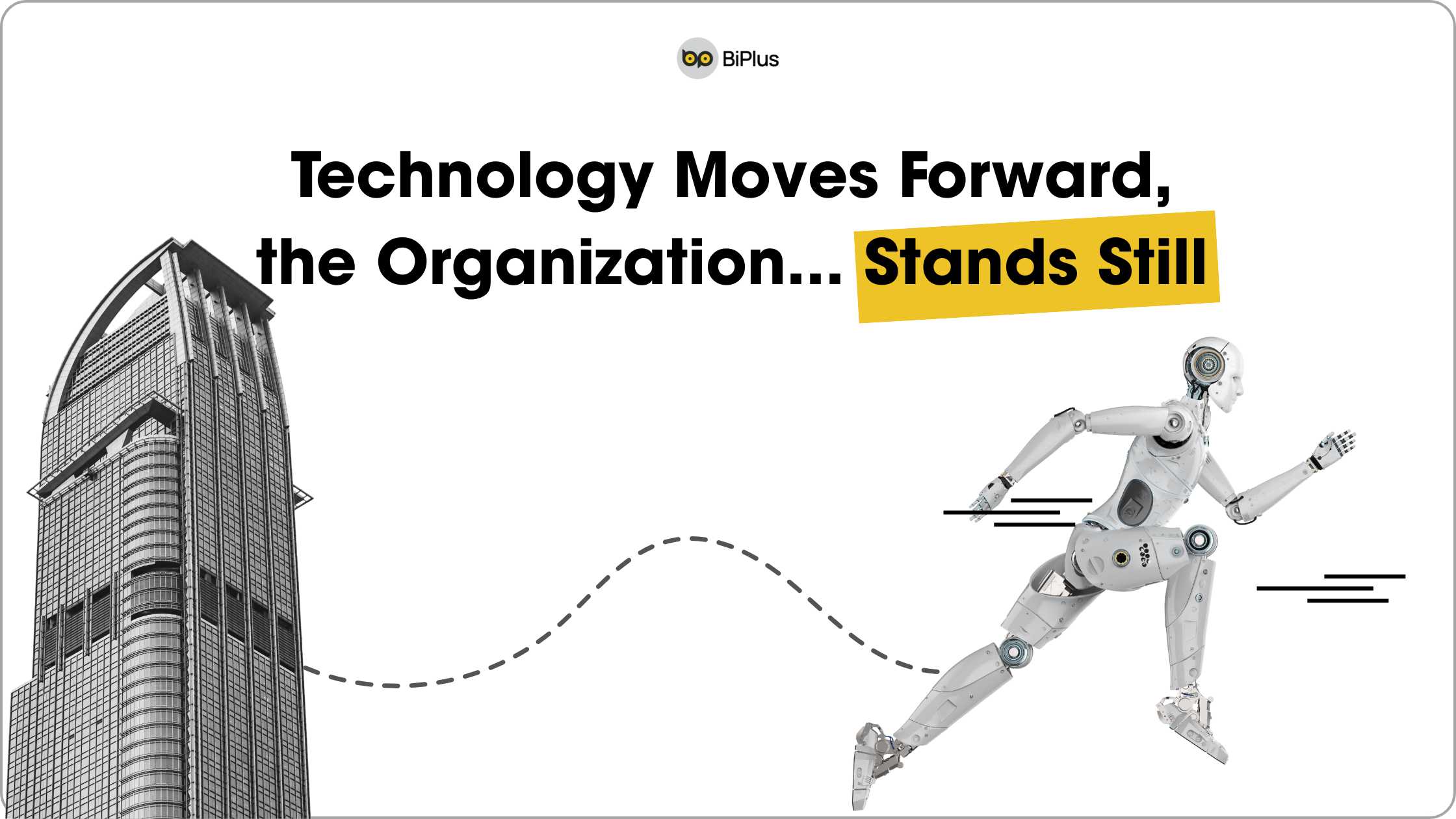
A closer look at stalled or abandoned AI initiatives reveals a familiar pattern. The technical implementation is often correct, and sometimes excellent, but the organization fails to evolve alongside it.
AI engineers can confidently explain model selection, data pipelines, and performance optimization. But AI does not live in notebooks. It lives in credit approval workflows, compliance rules, call center KPIs, and legacy systems that have been running for years.
When no one fully understands the organizational context well enough to redesign workflows from start to finish, embedding AI into processes, governance, and value measurement, even the best models remain stuck at the demo stage. This is the so called proof of concept graveyard, where promising experiments never scale, no one can demonstrate concrete value, and there is no clear decision to move forward or stop.
The biggest gap usually appears after the demo. Who works with legal and compliance teams. Who updates processes, standard operating procedures, and access controls. Who designs monitoring, logging, and human in the loop mechanisms. Who trains users, revises KPIs, and manages internal communication. Without clear ownership of these responsibilities, AI initiatives almost inevitably stall at the proof of concept phase, regardless of how strong the technical execution may be.
The Missing Link: AI-Native Change Agent
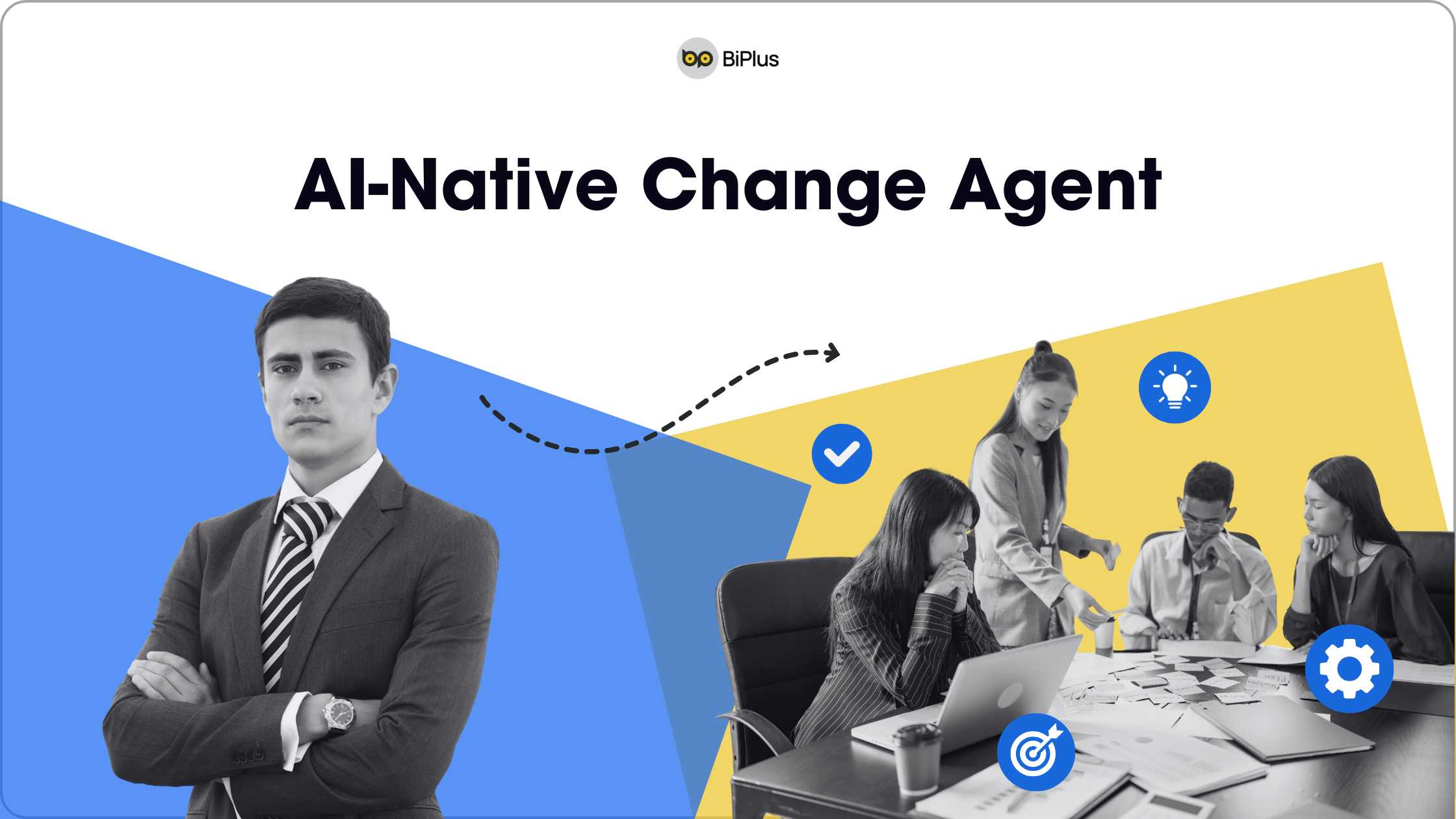
On one side, AI technology evolves week by week. On the other, enterprises operate within processes, data constraints, regulations, and cultures that require time to adapt. Bridging this gap calls for a new type of role, one that understands both technology and business.
This role can be described as an AI-Native Change Agent. The label itself matters less than what the role delivers in practice. These individuals ensure that every AI initiative starts with business value, not with tools. Before discussing models or architecture, they help stakeholders align on three fundamentals. The business problem to be solved, the metrics that define success, and the cost of inaction over the next 6 to 12 months.
Rather than attaching AI to existing processes, they redesign workflows. Working closely with business teams, they analyze current processes, identify bottlenecks, and build AI enabled versions. Which steps can be automated, which still require human judgment, who approves what, who monitors outcomes, and how data flows are all made explicit. Instead of attempting large scale change, they focus on targeted interventions that deliver tangible improvements, such as reducing processing time by 25-30% or significantly shortening response times for repetitive customer requests.
Governance and risk management are embedded from day one. In industries such as banking, finance, and insurance, even the most advanced models will struggle to move forward without meeting security, legal, and audit requirements. The change agent works early with relevant stakeholders to align on data scope, logging mechanisms, model boundaries, and error handling processes.
Most importantly, they translate AI success into numbers. Instead of declaring an AI project successful, they demonstrate how much processing time was reduced, how many full time equivalent roles were saved, and what the estimated annual impact looks like. This is what allows AI to become an essential part of operations, rather than an interesting experiment.
From "Having AI Engineers" to "Building AI-Native Capability"
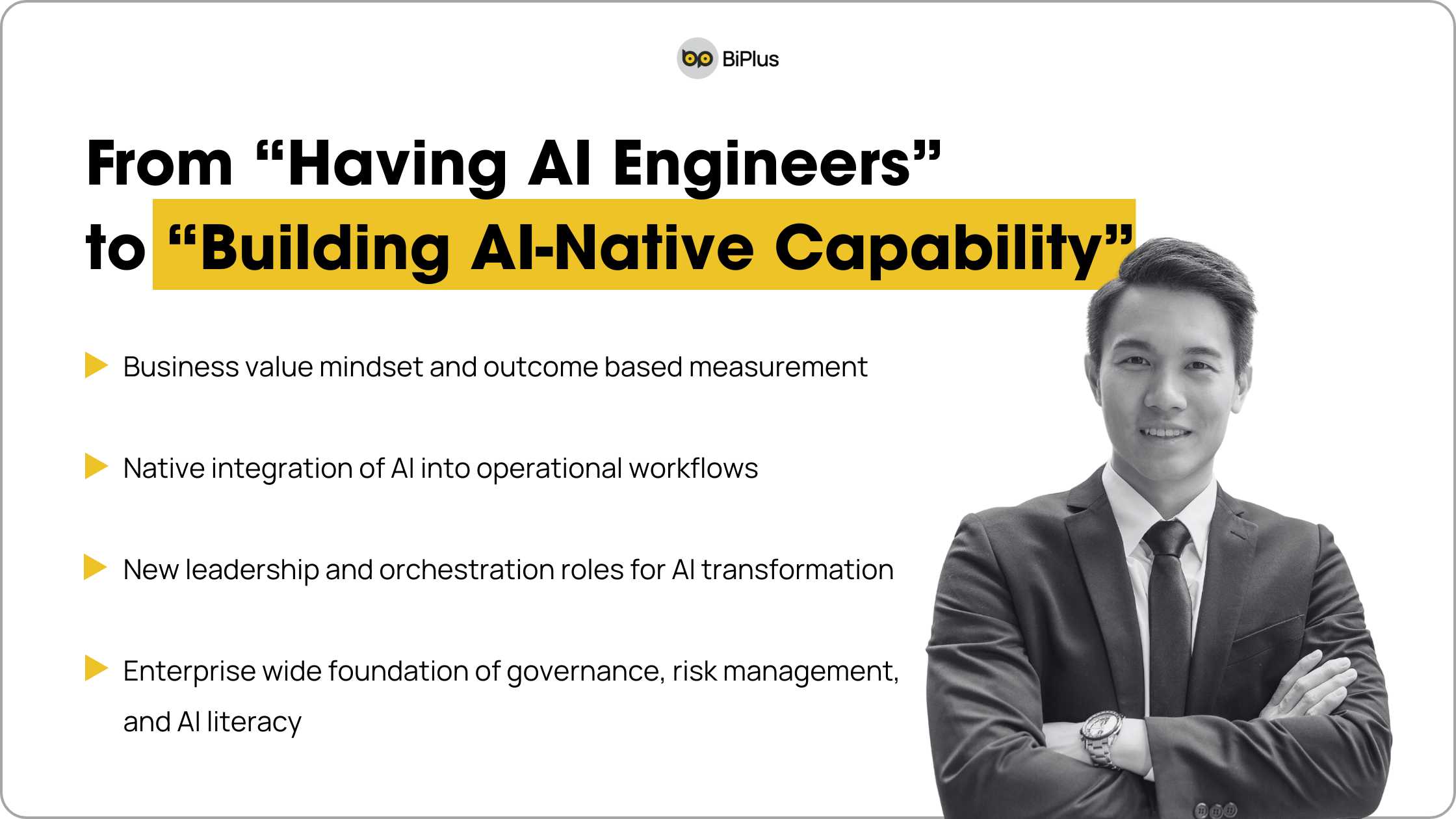
If AI is viewed purely as a technology race, the conversation revolves around which model to use, which tools to test, or how many PoC initiatives are running. But when AI is treated as the foundation of a new organizational capability, the questions change.
Organizations begin to ask how many processes are natively integrated with AI, how many AI initiatives have clearly defined KPIs that are measured after deployment, and how many use cases move beyond PoC into stable operations that users adopt and that generate repeatable value.
This shift requires organizational change. Technical teams cannot be expected to carry the transformation alone. New roles are needed, whether they are called change agents, catalysts, or AI champions, as long as they take ownership of critical responsibilities. These include connecting business value to AI capability, redesigning workflows, orchestrating stakeholders, embedding governance early, and measuring value with data.
At an individual level, this transition presents more opportunity than risk. Whether someone works in engineering, operations, business, or management, understanding how AI fits into processes and how its value is measured elevates their role. Instead of replacing people, AI becomes a tool to reduce repetitive work and support better decision making.
To make this possible, organizations cannot rely solely on experimenting with tools. They must invest in foundational capabilities, including AI literacy across the enterprise and transformation leadership for key roles. This is also the moment for organizations to proactively seek partners with hands on experience to co create a realistic and effective roadmap.
BiPlus - A Trusted AI-Native Transformation Partner in Vietnam
AI creates value only when organizations change their mindset and operating model, not when they simply add more tools or PoC initiatives. The gap between AI investment and business outcomes stems from the lack of a structured approach to embedding AI into processes, people, and value measurement.
As an official Scaled Agile partner and one of the pioneers of AI-Native Organization in Vietnam, BiPlus approaches AI as the next evolution of Agile. The focus is on helping enterprises move from Agile to AI driven, with AI Agents as the core, gradually commercializing internal AI capabilities to generate real, measurable value.
Through consulting, implementation, and AI-Native training programs, including the AI-Native Foundation, BiPlus partners with organizations to build the capabilities required to bring AI from experimentation into daily operations. For organizations still defining their AI transformation direction, engaging with BiPlus early can help clarify the problem space and focus efforts on steps that deliver tangible business value.