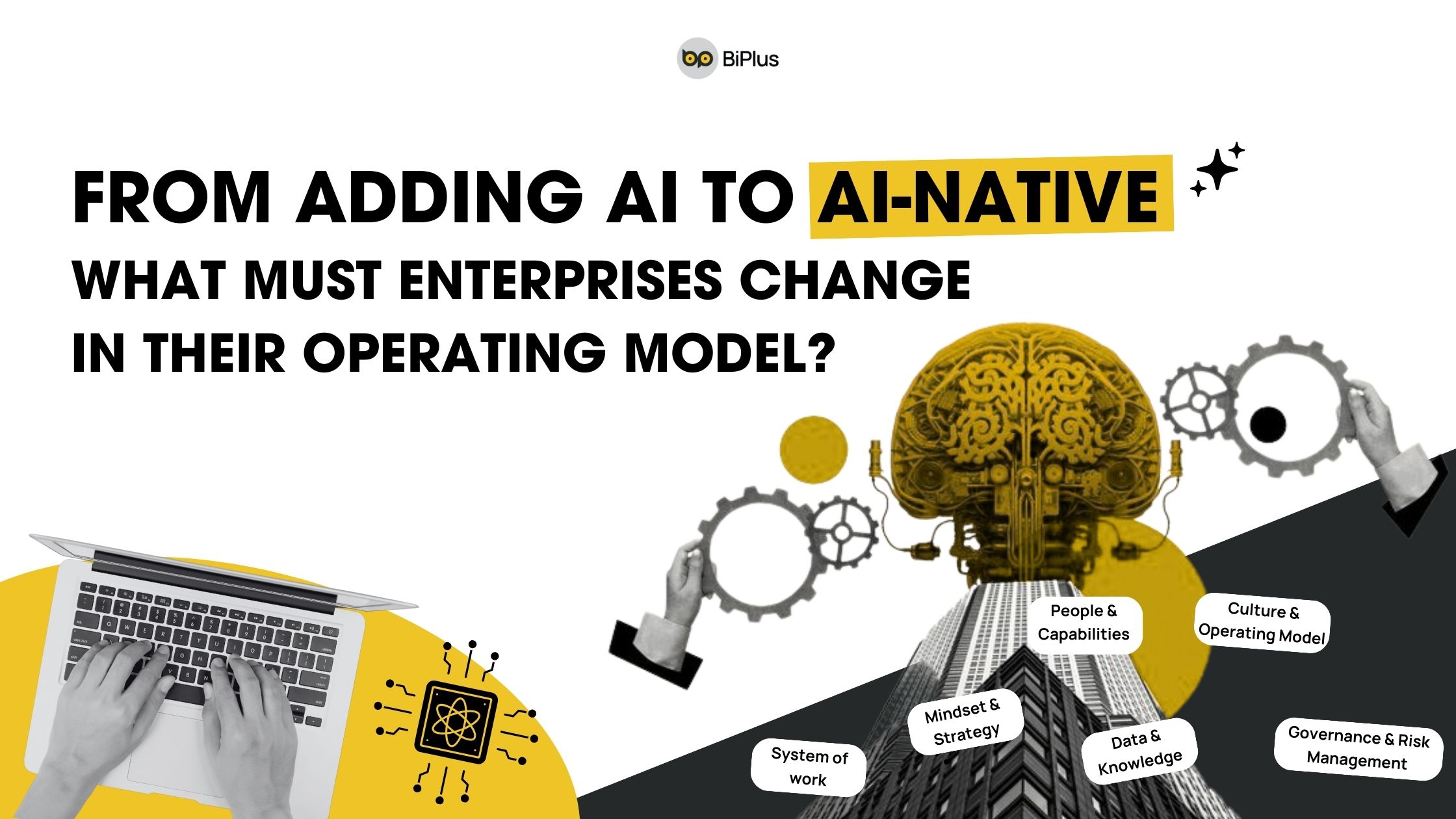
In just a few short years, AI powered capabilities have become common across enterprise platforms and products, from work management software to customer support systems. Almost any tool today can add a few AI features and quickly present itself as more advanced.
However, as AI moves from experimentation into real world deployment, a critical question becomes increasingly clear. Is adding a few AI features enough to create long term business impact, or does AI require a deeper and more systemic approach?
This is where the concept of AI-Native gains attention, not only as a technology term, but as a new way of thinking about how organizations operate with AI.
Defining AI-Native from a Business Perspective
AI-Native as a Natural Part of How an Organization Operates
AI-Native is not simply about introducing intelligent tools into existing processes. From a business perspective, AI-Native describes a state in which AI becomes a foundational capability, embedded across operations, decision making, and innovation.
Rather than existing as an additional feature, AI is integrated directly into workflows, into the system of work, and into how the organization creates value. Decisions rely less on intuition or individual experience and are continuously supported by data, models, and AI generated insights.
In this sense, AI-Native is not about whether an organization uses AI, but about whether AI actively shapes how the organization works.
What an AI-Native Organization Looks Like in Practice?
In an AI-Native organization, AI is present across functions such as Marketing, HR, Development, and Operations. The key difference lies in how these uses of AI are connected.
Instead of operating in isolation, the organization follows a shared structure:
Marketing, HR, Product, Engineering, and Operations use AI within a common governance framework covering data, security, KPIs, and quality standards.
Strategic and day to day operational decisions are supported by AI driven insights, allowing the organization to respond faster and more consistently.
Most importantly, employees do not use AI only for convenience. They understand how AI influences their work and actively propose improvements based on data, rather than following predefined processes.
At the team level, AI also moves beyond individual experimentation. In AI-Native organizations, teams often work alongside an AI teammate that has been properly onboarded with relevant data, workflows, and quality standards. This AI supports the entire team within a shared and clearly defined workflow.
At this point, AI is no longer a personal productivity tool. It becomes part of the enterprise operating model.
Bolted-on AI and Baked-in AI as Two Common Approaches
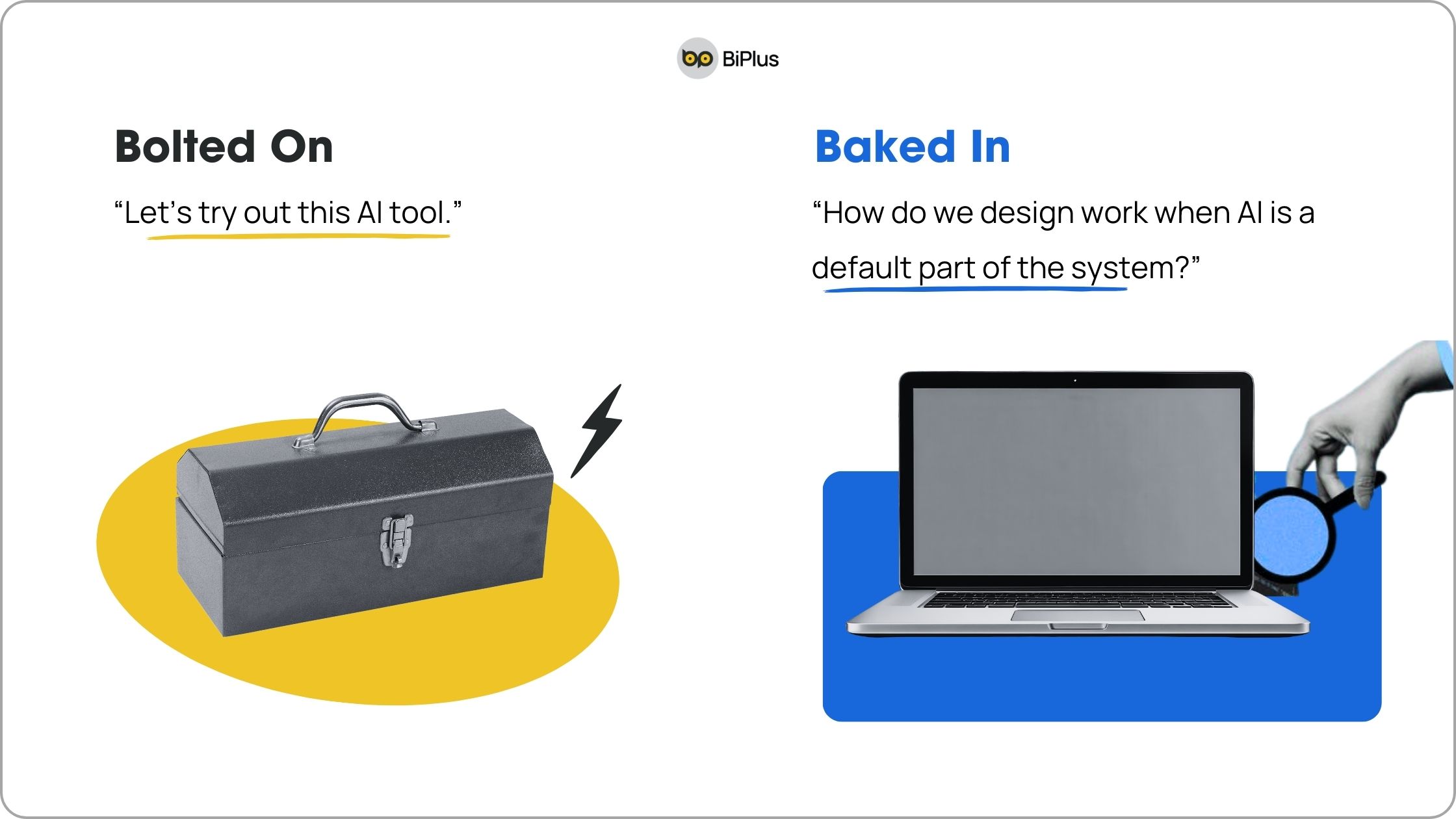
When discussing AI-Native transformation, most organizations today fall into one of two approaches.
Bolted-on AI: Adding AI While Keeping Existing Processes
This is the most common approach. AI is introduced as tools, plugins, chatbots, or smart features at specific points within existing workflows.
This approach often delivers quick results in the early stages. However, the core workflows remain largely unchanged. Different departments select different tools, data becomes fragmented, success metrics are inconsistent, and it becomes difficult to assess the overall impact of AI at the organizational level.
Baked-in AI: Designing Processes with AI at the Core
In contrast, some organizations take a more deliberate and foundational approach. Instead of attaching AI to existing workflows, they redesign processes from the beginning, with AI considered as a core element of the operating structure.
This approach often introduces new roles such as AI champions, change agents, or governance boards. It also requires changes in mindset, collaboration across functions, and decision making practices.
Long Term Implications of Each Approach
Bolted-on AI enables faster deployment with minimal disruption. Over time, however, it often leads to fragmentation, limited scalability, and unclear value measurement.
Baked-in AI typically starts with fewer use cases, but each use case is closely tied to value streams, has clear success metrics, and can be scaled once its effectiveness is proven.
This distinction forms the foundation for moving from isolated AI initiatives toward a structured AI-Native roadmap.
Core Pillars for Building an AI-Native Organization
Moving toward AI-Native requires organizations to view AI as a systemic challenge rather than a purely technical upgrade. Based on key success factors, AI-Native organizations tend to follow these principles.
1. Anchor AI to Business Value
AI creates impact only when it acts as a true business lever. Each initiative should be explicitly connected to performance outcomes so value is measurable, repeatable, and directly aligned with the bottom line. When this link is clear, AI becomes part of the growth engine rather than a collection of isolated experiments.
2. Upskill Relentlessly
AI evolves at a pace that leaves no room for one time learning. AI-Native organizations build capability by continuously learning and doing, staying aligned with each breakthrough and turning new advances into practical advantages within their own context.
3. Introduce AI Early in Planning
The strongest results emerge when AI is not treated as an afterthought. By bringing AI into the conversation early, during problem framing and process design, organizations uncover opportunities that traditional approaches often miss and explore outcomes that would otherwise feel out of reach.
4. Move Fast and Learn Faster
Progress compounds when teams experiment with intent. AI enables faster testing, lower risk, and quicker iteration. The goal is not speed alone, but the ability to learn rapidly from real data and scale what delivers meaningful impact.
5. Provide Clear Context for AI
AI performs best when it understands the full context. When goals, constraints, stakeholders, and evaluation criteria are clearly defined, AI shifts from a black box tool into a trusted collaborator that helps teams align faster and make smarter decisions together.
6. Embed AI into Daily Workflows
AI creates the most value when it becomes part of everyday work rather than a special initiative. Embedded into daily workflows, AI supports better decisions and unlocks new ideas that might not surface through traditional ways of working.
7. Balance Innovation with Intentional Governance
Innovation without accountability introduces risk. Guiding AI with clear guardrails ensures that speed does not outpace responsibility. Over time, this balance between innovation and governance builds trust, which becomes a lasting competitive advantage.
AI-Native is not only about technology. It represents the integration of technology, people, processes, data, and organizational culture.
Why Enterprises Should Shift from Isolated AI Projects to an AI-Native Roadmap
Many enterprises have launched multiple AI initiatives in recent years. However, results are often fragmented and fail to create lasting impact at the organizational level.
An AI-Native approach helps enterprises:
Avoid trend driven adoption and focus resources on a small number of priority value streams.
Measure, optimize, and scale use cases that have already proven their effectiveness, rather than running isolated experiments and moving on.
Build an operating foundation flexible enough to adapt to future waves of technology.
Ensure risk management, compliance, and transparency throughout AI adoption.
A practical starting point is to assess the current state. Organizations should identify where they sit on the spectrum between bolted-on AI and AI-Native, understand existing strengths, uncover operational bottlenecks, and determine which value streams should be prioritized for transformation.bottlenecks, and determine which value streams should be prioritized.
The Role of BiPlus in the AI-Native Journey
With experience supporting large enterprises in Scaled Agile and operational transformation, BiPlus views AI-Native as the next stage in the Agile journey.
Rather than applying predefined models, BiPlus works closely with organizations to design AI-Native roadmaps that align with their context, goals, and existing capabilities. The focus is not on adopting AI for its own sake, but on enabling AI to create real value within the system of work.
BiPlus typically partners with enterprises across the following areas:
AI-Native strategy consulting and roadmap design aligned with priority value streams.
Assessment of current operating maturity, data readiness, governance structures, and AI capabilities.
Design of governance frameworks, operating models, and system of work that enable AI to be activated, scaled, and sustained over time.
If you are considering how to embed AI into your operations in a structured and systematic way, you can connect with the BiPlus team to review your current state and discuss the most suitable strategic options.
👉 Connect with BiPlus to explore AI-Native for your enterprise.