In the current wave of digital transformation, AI is often hailed as the "silver bullet" for IT operations, promised to vanish the mountain of tickets overnight. However, a striking paradox has emerged: the more advanced the technology, the higher the margin for error if the underlying foundation is weak.
At BiPlus, we often see organizations attempting to layer sophisticated AI on top of shaky ground. When ticket data lacks context, the Knowledge Base has been neglected for years, and IT assets aren't clearly identified, AI doesn't just fail-it hallucinates. Instead of speeding up resolutions, IT teams end up spending more time verifying AI-generated errors.
To truly unlock the value of AI, we must return to the core: standardizing data and processes first. AI is a powerful optimizer, not a replacement for a broken service management system.
Standardizing the AI Mindset: A Strategic Framework for Modern ITSM
In an era where AI tools are abundant yet often fragmented, organizations must establish a clear reference frame to evaluate their current capabilities and define long-term objectives. Without a standardized mindset, AI implementation risks becoming a series of disconnected experiments rather than a cohesive driver of operational excellence.
The 6C Framework: Core Competencies of AI-Native Service Management
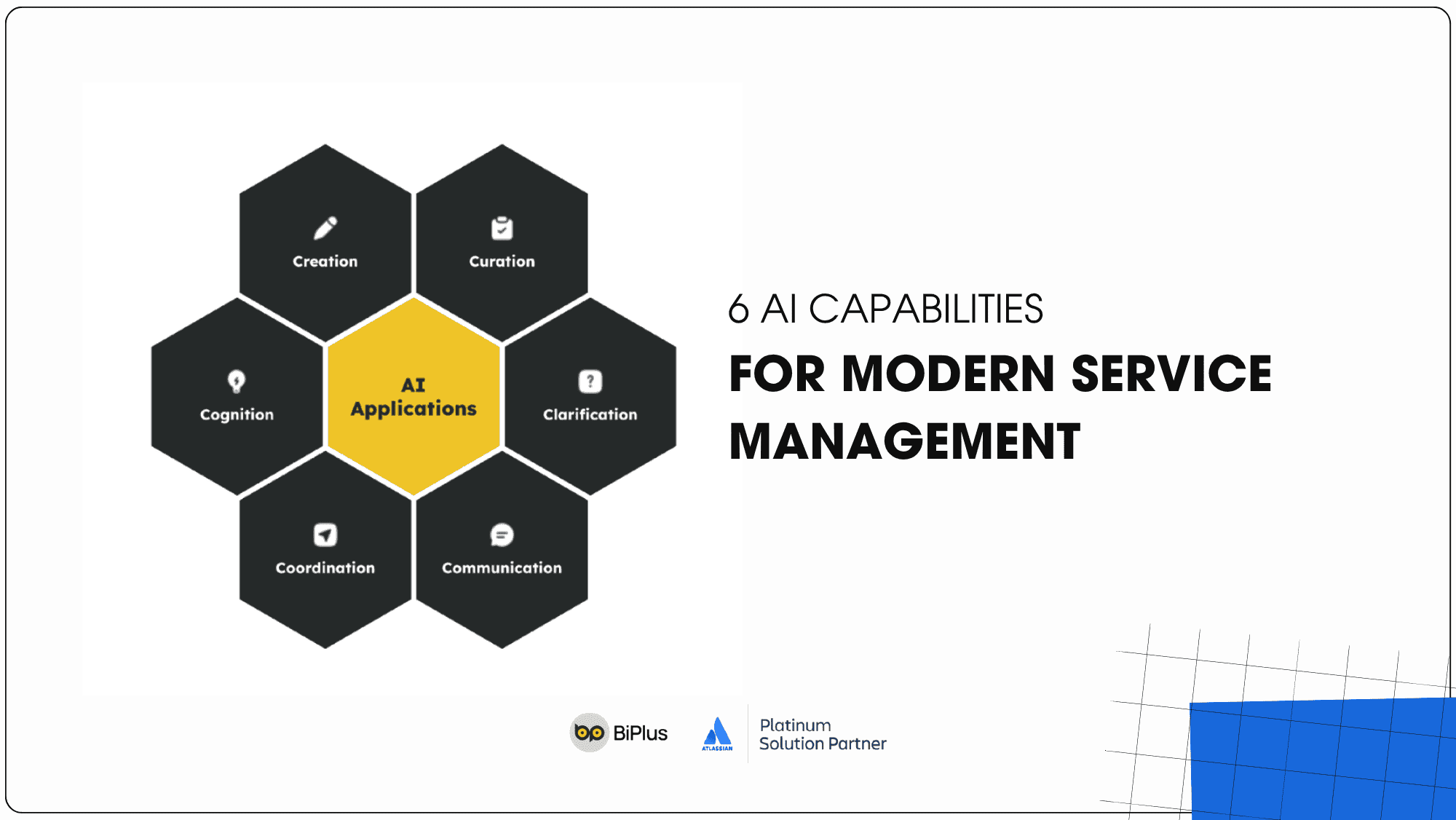
The shift toward an AI-Native environment requires a system that moves beyond simple troubleshooting into intelligent service orchestration. The 6C Framework defines the six core pillars necessary for this transformation:
Creation: AI moves beyond templates by drafting context-aware solution articles and personalized responses tailored to the specific nuances of each user request.
Curation: To maintain a "healthy" corporate brain, AI proactively audits the Knowledge Base, flagging outdated content and suggesting updates to ensure information remains accurate and actionable.
Clarification: By interacting with users at the point of entry, AI gathers missing details and clarifies intent before a ticket ever reaches a human agent, ensuring every request is "action-ready."
Cognition: Leveraging deep data analysis, AI identifies hidden incident trends and correlations, allowing IT teams to shift from reactive firefighting to proactive problem prevention.
Communication: AI facilitates natural, multi-channel interactions (via Slack, Teams, or Portals), providing a seamless and personalized user experience that feels human-centric.
Coordination: Through skill-based routing, AI automatically orchestrates workflows by assigning tickets to the most qualified experts based on their specific skill sets and historical success rates.
The AI Maturity Model: Navigating Your Path to Autonomy
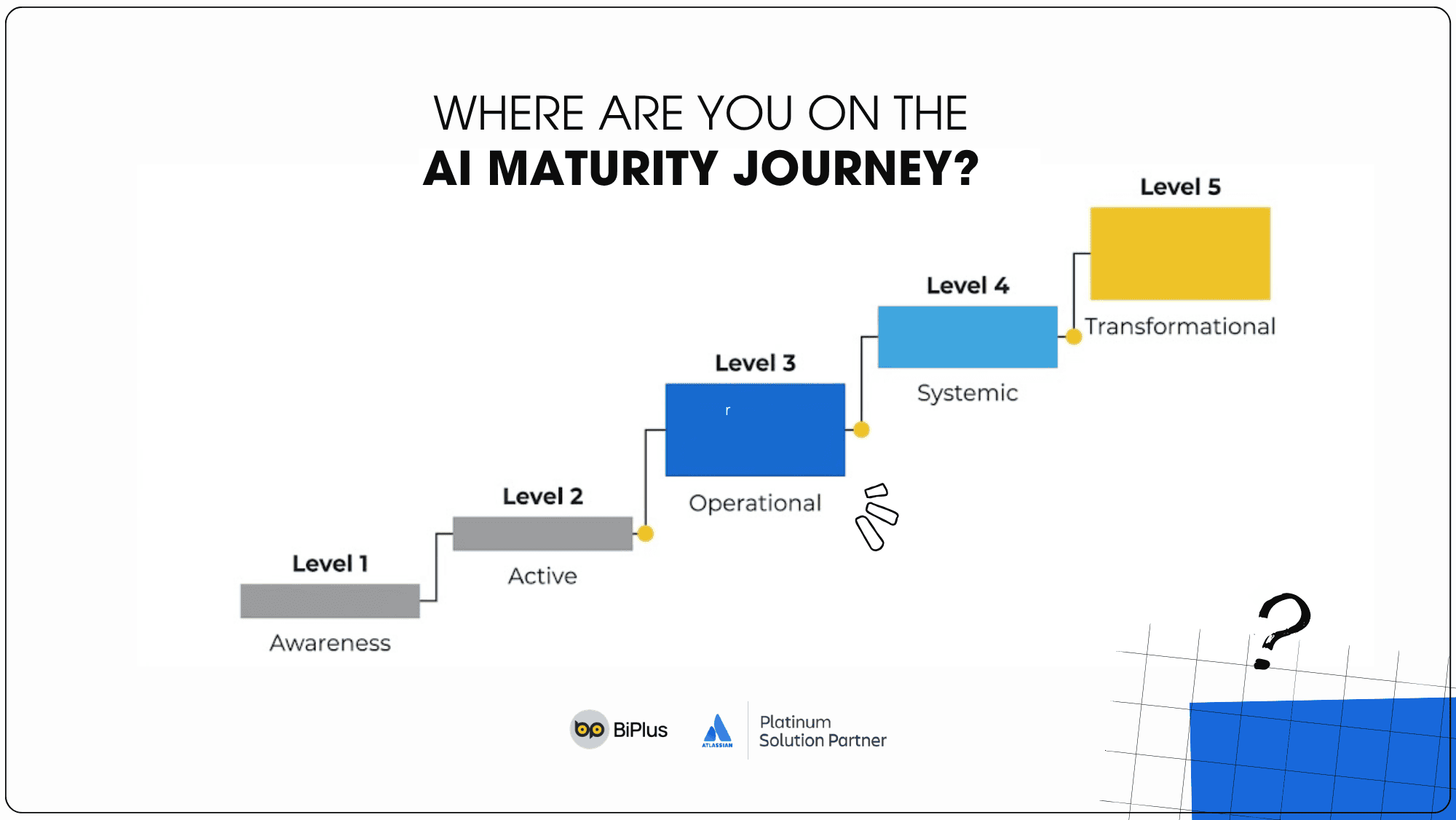
Identifying your organization's current position on the maturity scale is vital for setting realistic ROI expectations and building a sustainable implementation roadmap:
Level 1 - Manual: Operations are entirely human-dependent, with data siloed in emails, spreadsheets, or disparate legacy systems.
Level 2 - Assisted: Basic AI integration begins, primarily used for summarizing ticket history or suggesting relevant knowledge base articles to agents.
Level 3 - Augmented: AI acts as a true co-pilot, proactively suggesting next steps and resolution paths for agents based on real-time operational data.
Level 4 - Autonomous: The system achieves self-sufficiency for "Standard Requests" (e.g., access provisioning or password resets), executing workflows end-to-end without human intervention.
Level 5 - Cognitive: The pinnacle of maturity, where the system self-learns and autonomously optimizes operational processes based on historical outcomes and user feedback.
This evolution represents more than just a technical upgrade; it is a fundamental shift in operational philosophy. For a deeper dive into this transition, explore our insights on Moving from ITSM to Digital Service Management (DSM) in the AI Era.
The BiPlus 3-Step Roadmap to AI Success: From Foundation to Autonomy
Implementing AI in ITSM is a marathon, not a sprint. To ensure your investment delivers tangible business value rather than just technical novelty, BiPlus recommends a structured three-step journey. This roadmap focuses on building a resilient foundation before scaling to advanced cognitive operations.
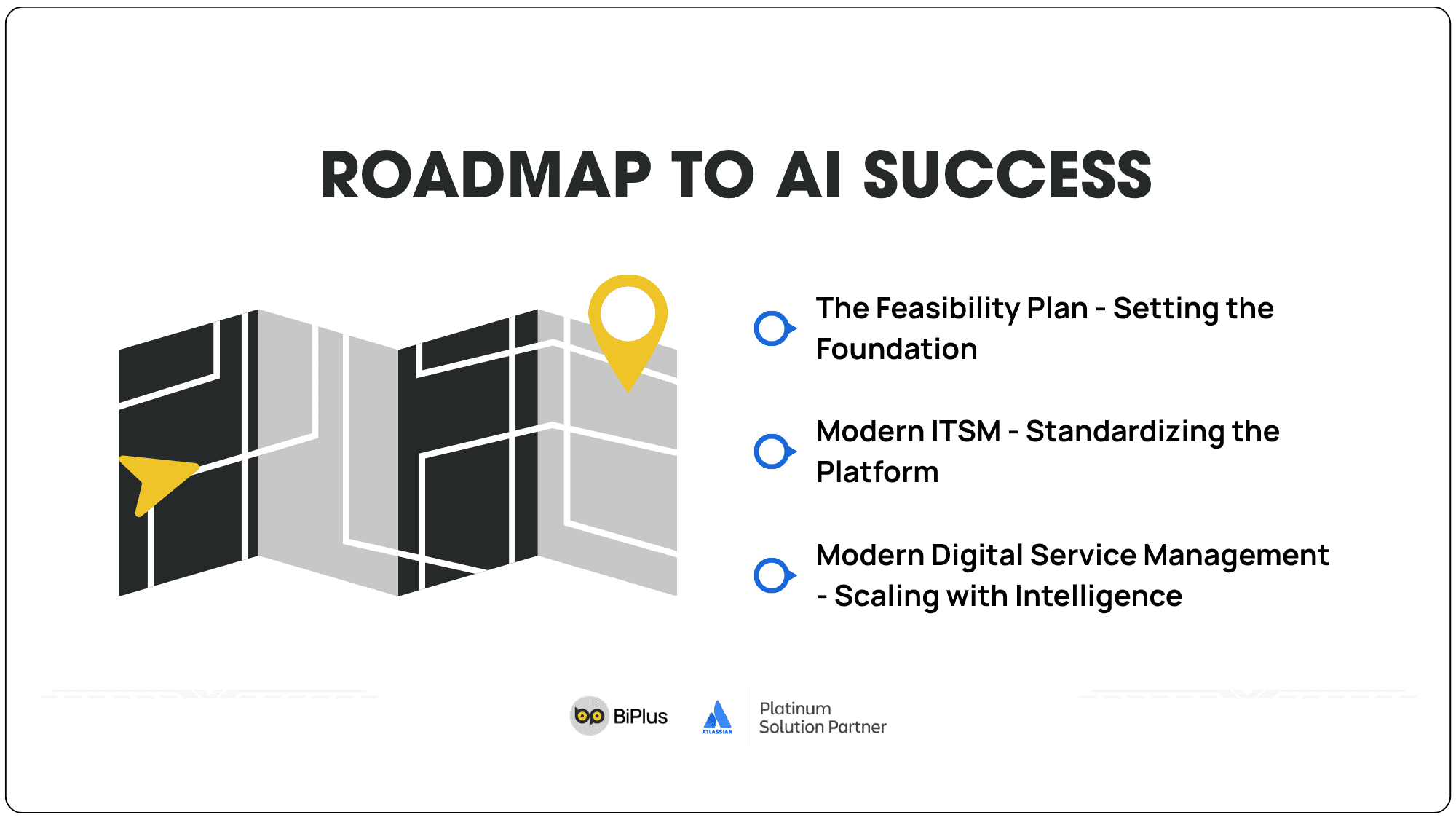
Step 1: The Feasibility Plan - Setting the Foundation
Before deploying any AI model, you must ensure the "fuel" (your data) is clean and the engine (your strategy) is tuned.
Data Quality Audit & Atomic Content: AI thrives on structured, high-quality information. We begin by auditing your existing Knowledge Base and documentation. The goal is to transition from long, monolithic documents to Atomic Content - small, modular, and highly specific information snippets. This allows AI to retrieve and present precise answers rather than forcing users to hunt through 20-page PDFs.
Identifying Quick Wins: To build internal momentum and prove ROI, we identify 3 to 5 high-volume, low-complexity processes. These are typically repetitive tasks like password resets or software access requests where AI can provide immediate relief to the IT service desk.
Defining Success with KPIs: We move beyond vanity metrics. Success is measured through specific Key Performance Indicators such as Self-Service Deflection Rate (how many issues were solved without an agent), Mean Time to Resolution (MTTR), and AI Accuracy Scores based on user feedback.
Step 2: Modern ITSM - Standardizing the Platform
Once the foundation is set, we integrate AI into the heart of your IT operations to create a unified ecosystem.
Building the Teamwork Graph: We leverage the Atlassian ecosystem to connect the dots between different workstreams. By integrating JSM for request tracking, Confluence for the knowledge layer, and Opsgenie for incident alerting, we create a Teamwork Graph. This provides the AI with full situational awareness, allowing it to understand the relationship between a reported bug, a server alert, and the relevant fix documentation.
Smart CMDB Integration: A static CMDB is a liability. We implement a Smart CMDB that updates in real-time. When AI has access to accurate, up-to-date asset data, it can perform root-cause analysis with surgical precision, identifying exactly which hardware or software component is triggering an incident.
Standardizing via Structured Input: To minimize "noise," we redesign Portal forms using Structured Input. By using dynamic fields and logic-based forms, we ensure that the data AI receives is clean and categorized from the moment a user hits submit, drastically reducing the need for manual clarification.
Step 3: Modern Digital Service Management - Scaling with Intelligence
In the final stage, we move beyond traditional IT boundaries to achieve true Digital Service Management (DSM), where AI drives continuous innovation.
Leveraging Atlassian Rovo: We introduce Atlassian Rovo, an AI-powered agent that acts as a connective tissue across your entire organization. Rovo allows your team to find, learn, and act on information siloed across third-party tools like Google Drive, Slack, and SharePoint, all through a single conversational interface.
Establishing a Continuous Feedback Loop: AI is not a set and forget tool. We implement a robust Feedback Loop where IT agents and end-users rate the helpfulness of AI suggestions. This Human-in-the-loop data is fed back into the system to fine-tune the models, ensuring the AI evolves alongside your unique business logic and terminology.
Cultivating an AI-First Culture: The ultimate goal is a cultural shift. We help your IT team transition from being "ticket processors" to "AI Orchestrators." In an AI-First Culture, the team focuses on auditing AI outputs, improving the Knowledge Base, and solving complex architectural problems, while the AI handles the high-frequency operational load.
By following this roadmap, BiPlus ensures that your transition to AI-Native ITSM is not only smooth but also delivers a measurable competitive advantage in the APAC fintech and tech landscape.
Real-World Impact: Practical AI Use Cases in Modern IT Operations
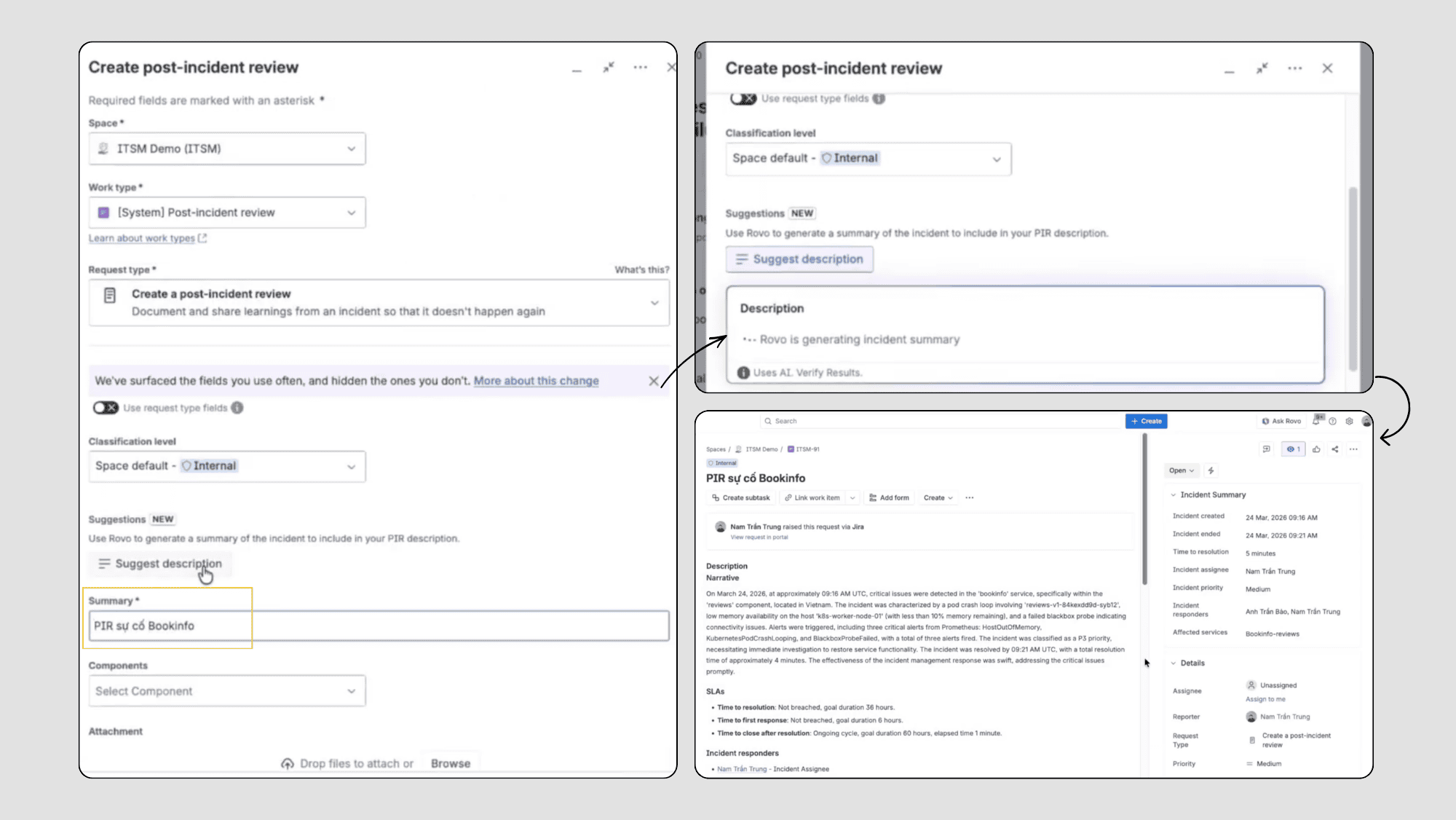
At BiPlus, through our extensive experience consulting for large-scale enterprises, we have identified and categorized over 121 practical AI use cases specifically designed for IT operations. These are not just theoretical concepts; they are functional applications that drive measurable efficiency.
Below are the high-impact use cases that are currently transforming the ITSM landscape:
Automated Post-Incident Reviews (PIR): Traditionally, documenting a major incident takes hours of manual labor. AI can now scan through chat logs (Slack/Teams), system alerts, and ticket history to automatically draft a comprehensive PIR report. This ensures that lessons are learned and documented without draining your senior engineers' time.
Multi-channel Virtual Agents: By integrating AI directly into the platforms where your employees already work, such as Slack or Microsoft Teams - you provide a seamless support experience. These virtual agents can guide users through self-resolution steps or fulfill standard requests (like password resets) instantly, preventing a ticket from ever being created.
Predictive Trend Analysis & Proactive Prevention: AI doesn't just react; it anticipates. By analyzing historical data patterns, AI can identify hidden correlations that precede a system failure. This allows your IT team to intervene before an outage occurs, shifting the department from a "cost center" to a "value protector."
Intelligent Ticket Categorization & Sentiment Analysis: AI automatically analyzes the language and urgency of incoming requests. It can prioritize tickets not just by type, but by the user's sentiment, ensuring that high-frustration or business-critical issues are escalated to the right expert immediately.
Frequently Asked Questions
Q1: Is our data secure when using AI?
A: Absolutely. BiPlus implements enterprise-grade AI solutions like Atlassian Intelligence. Your data is encrypted, kept within your secure tenant, and never used to train public models, ensuring full compliance with GDPR and SOC2 standards.
Q2: Will AI replace our IT staff?
A: No. AI is an accelerator, not a replacement. By automating repetitive, low-value tasks, it liberates your team to focus on high-level architecture, security strategy, and innovation - areas where human judgment remains irreplaceable.
Q3: How soon can we expect a measurable ROI?
A: By targeting "Quick Wins" in Step 1, most organizations see a significant drop in ticket volume and MTTR within 3 to 6 months. The ROI compounds as the system evolves toward fully autonomous workflows.
Q4: Can we start with AI if our current data is "messy"?
A: Yes. You don't need perfect data to start, but you need a strategy. Our roadmap begins by fixing the foundation - transforming your information into "Atomic Content" to clean the fuel while the AI engine is being built.
Summary & Key Takeaways
AI in ITSM is no longer a futuristic luxury; it is a foundational requirement for operational excellence in the digital age. However, the secret to success lies not in the tool itself, but in the standardization of data and the maturity of your roadmap.
Standardize first: AI is an optimizer; it cannot fix a broken process.
Think Atomic: Break your knowledge into modular pieces for AI to digest.
Human-in-the-loop: Use AI to empower your team, not to operate in a vacuum.
Ready to build a future-proof IT department?
Don't let the complexity of AI hold you back. Whether you are just starting your journey or looking to optimize an existing system, BiPlus is here to guide you through every step of the AI Maturity Model.
Connect with a BiPlus Expert Today
Get a personalized assessment of your IT infrastructure and a tailored AI implementation strategy.
Explore our Modern ITSM eBook to learn the detailed roadmap for building an AI-ready ITSM system.