In the global wave of digital transformation, AI is no longer just a supporting tool. It is becoming a true digital collaborator for businesses. One of the most significant advancements today is Agentic AI (autonomous artificial intelligence), which can plan, make decisions, and act to achieve human-defined goals. So, what is Agentic AI, how does it differ from previous AI generations, and what opportunities and challenges does it present for Vietnamese enterprises?
What is Agentic AI?
According to IBM, while Generative AI primarily creates new content based on learned data, Agentic AI is a leap forward: it not only understands context and responds, but can also self-identify goals, plan, coordinate multiple tasks, and act independently to deliver outcomes.
Imagine simply saying, "Help me plan a business trip to Hanoi," and Agentic AI will automatically check your schedule, book flights and hotels, arrange transportation, and even remind you to bring an umbrella if rain is forecasted. All these tasks are proactively executed by AI in a pre-set workflow, without you having to guide each step or enter multiple commands.
Key features of Agentic AI include:
- Autonomy: Proactively plans and solves multi-step problems without constant supervision.
- Adaptability: Learns from real-world data and adjusts behavior based on feedback and environment.
- Specialization: Handles tasks from simple to complex, coordinating multiple agents simultaneously.
- Simple communication: Users can interact with AI using short, natural commands, just like talking to a real person. No need for lengthy or detailed instructions; the AI agent will understand, execute, and deliver the desired result.
How does Agentic AI work?
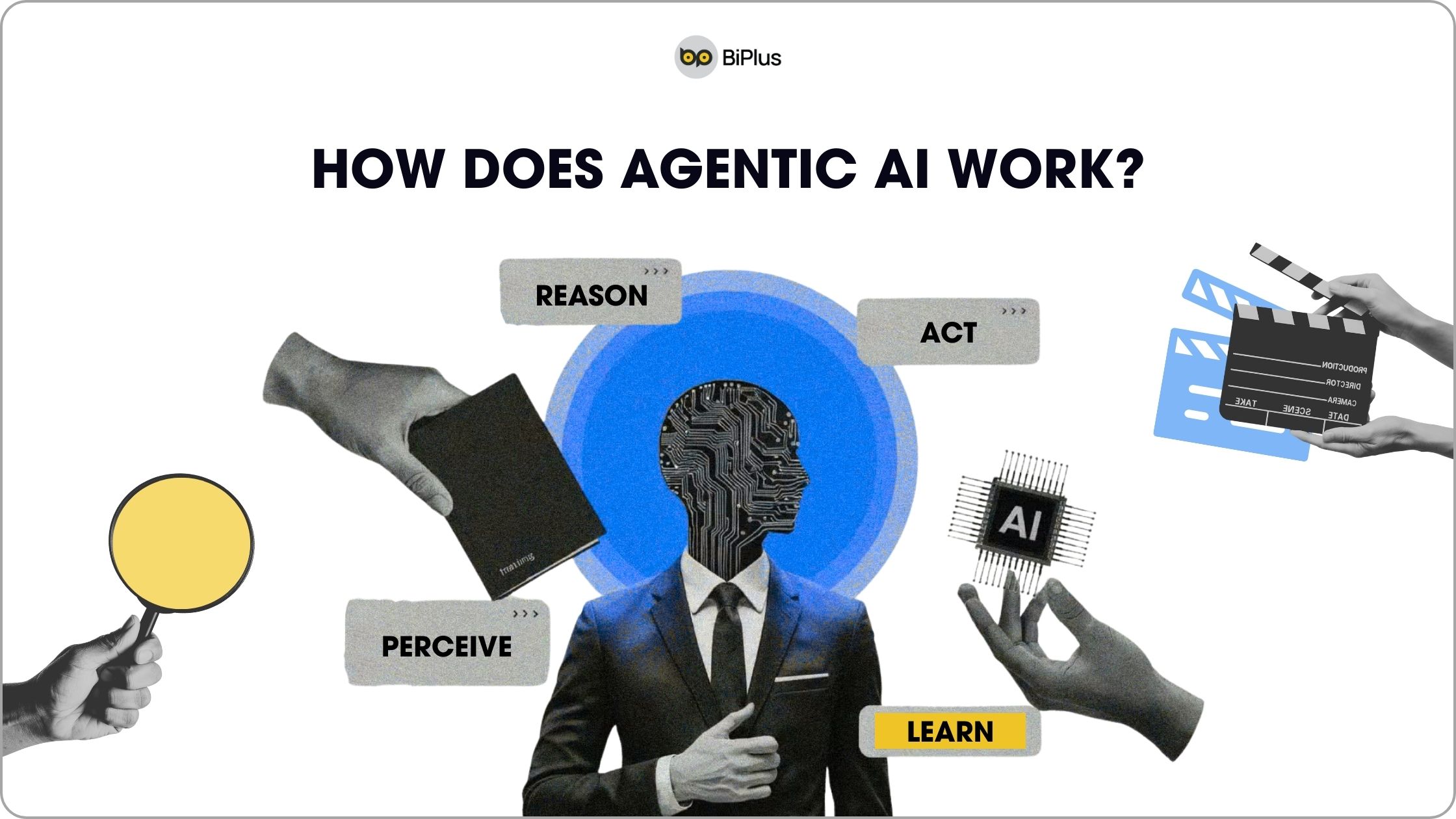
An Agentic AI system does not simply respond to commands; it operates through a closed, intelligent, and continuously evolving loop with four main steps:
Perceive:
Agentic AI begins by collecting and receiving data from various sources such as traditional databases, IoT sensors, enterprise management systems, or even real-time internet data. By aggregating and analyzing diverse data, AI gains a comprehensive understanding of the context, identifies relevant factors, and recognizes situations that require action. This foundation enables AI to make informed decisions.
Reason:
After understanding the context, Agentic AI uses large language models (LLMs) and analytical algorithms to define goals, evaluate options, and propose optimal solutions. It leverages both current data and prior knowledge, collaborating with specialized models to make the best decisions. This reasoning process allows AI to handle complex tasks, plan multi-step actions, and adapt to new situations.
Act:
With a plan in place, Agentic AI proactively executes necessary actions by interacting with external systems such as management software, smart devices, APIs, or digital platforms. It can automate processes, coordinate multiple tasks simultaneously, and ensure all activities are timely, safe, and efficient. This autonomy means AI not only recommends but also directly creates tangible value for the business.
Learn:
A major differentiator for Agentic AI is its ability to learn continuously. After each action, AI records outcomes, analyzes feedback from users or systems, and adjusts future decisions for optimization. This ongoing learning process makes AI smarter, more adaptable to changing environments, and increasingly effective over time.
As a result, Agentic AI not only reacts but also predicts, optimizes, and improves performance, functioning as a true member of the organization.
How is Agentic AI different from Generative AI and traditional AI Agents?
While all are part of the AI ecosystem, Generative AI, traditional AI Agents, and Agentic AI represent three distinct generations with different roles and capabilities. Generative AI creates new content, excelling at natural language processing. Traditional AI Agents mainly perform fixed tasks based on predefined scripts. Agentic AI, however, is a breakthrough: it not only understands and responds but also self-identifies goals, makes decisions, and acts flexibly in real-world environments.
Generative AI
- Focuses on creating new content (text, images, code, etc.)
- Excels at natural language processing and content generation
- Responds to prompts with low autonomy
- Learning is limited to fine-tuning on existing data
- Requires high human supervision
Traditional AI Agents
- Designed to execute specific, predefined tasks
- Operate based on fixed scripts or logic
- Offer medium autonomy can follow instructions but lack flexibility
- Learning capability is limited; logic rarely adapts
- Require medium level of human supervision
Agentic AI
- Goes beyond responding and executing: autonomously plans and acts on goals
- Self-identifies objectives, makes decisions, and adapts to real-world environments
- High level of autonom acts independently and adapts to changing situations
- Continuously learns and improves through feedback loops
- Requires low human supervision (can operate within set boundaries)
Key Takeaway
The biggest difference lies in autonomy and action. If Generative AI is like a content creator, and a basic AI Agent is an assistant following a checklist, then Agentic AI is a true collaborator: understanding goals, making decisions, and proactively acting as an effective team member.
Practical applications of Agentic AI
Customer service:
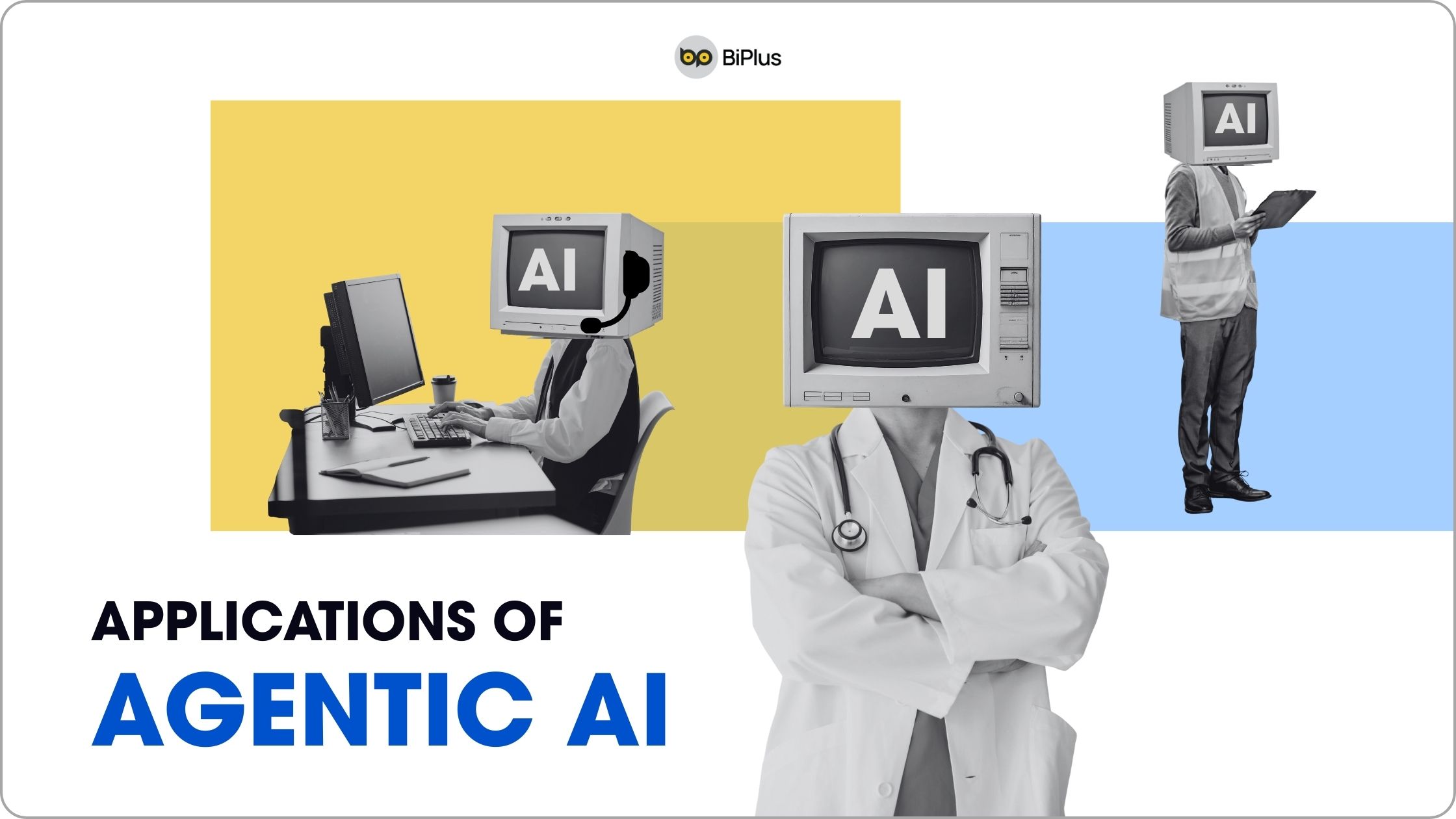
A bank deploys Agentic AI to automatically identify customers struggling with app services, proactively sending support messages or solutions via multi-channel chatbots (Zalo, Facebook, email) without the customer needing to contact the call center.
Supply chain management:
A retail company uses Agentic AI to continuously monitor inventory, forecast seasonal demand, automatically reorder from suppliers, and adjust delivery schedules in response to weather or traffic changes.
Healthcare:
A hospital applies Agentic AI to analyze medical records, support doctors in creating personalized treatment plans, automatically send appointment reminders, and handle administrative tasks like scheduling and payments.
Smart manufacturing:
A factory installs Agentic AI to monitor sensor data on production lines, predict equipment failures, automatically adjust operating speeds or maintenance schedules to minimize downtime and optimize productivity.
Digital system integration:
A smart building uses Agentic AI to connect lighting, HVAC, security, and energy management systems. AI proactively coordinates devices based on usage schedules, weather, and actual consumption, creating an optimal and cost-effective environment.
Challenges and notes when implementing Agentic AI

When deploying Agentic AI, businesses must clearly define goals that align with core organizational values. If objectives are not well-defined or do not reflect the company's direction, AI may make decisions and take actions that are misaligned, negatively impacting business outcomes.
Agentic AI must also adapt to ever-changing real-world environments, where input data may be incomplete or constantly shifting. This requires flexible systems capable of analyzing and adjusting strategies for each emerging situation.
Another major challenge is resources and cost. Building, training, and operating Agentic AI demands robust technology infrastructure, high technical expertise, and significant investment in both time and finances. Businesses should carefully evaluate to ensure ROI.
Finally, ethical and legal factors cannot be overlooked. Companies need transparent governance frameworks to ensure AI operates ethically, complies with regulations, and remains controllable. This reduces risk and builds trust among users and partners when applying Agentic AI in practice.
The future of Agentic AI
According to a forecast by Statista, the global Agentic AI market is expected to experience explosive growth between 2024 and 2030, with an average annual growth rate of over 44%. This figure not only demonstrates the strong development potential of Agentic AI technology but also highlights a clear shift among businesses worldwide toward applying autonomous AI in practical operations.
Agentic AI is expected to become a core foundation for digital transformation in enterprises. Unlike traditional generations of AI that only perform single tasks or respond according to predefined scripts, Agentic AI brings autonomy, adaptability, and flexible decision-making in real-world environments. This enables businesses not only to automate complex processes but also to optimize resources, minimize errors, and enhance operational efficiency.
One of the standout values of Agentic AI is its ability to personalize customer experiences at a deeper level. Thanks to real-time data analysis and automatic behavioral adjustments, Agentic AI helps businesses better understand each customer's needs and preferences, thereby building tailored care and service strategies that increase customer satisfaction and loyalty to the brand.
In addition, Agentic AI supports businesses in making faster and more accurate decisions thanks to its ability to continuously learn from new data and real-world feedback. Managers can rely on AI's analyses, forecasts, and recommendations to make strategic decisions, promptly seize opportunities, and adapt to market fluctuations.
Finally, with its flexible scalability, Agentic AI enables businesses to easily integrate new tools and platforms without disrupting current operations. This is a key factor in helping businesses maintain a competitive edge and be ready to adapt to any future changes.
In summary, Agentic AI is not just a technological leap but also sets a new standard for modern business operations. Organizations that pioneer the adoption of Agentic AI will have the opportunity to lead the market, optimize value, and create outstanding experiences for both customers and partners.
Overview of BiPlus's Agentic AI & System of Work Solution
After businesses have approached and built an AI-Native foundation with BiPlus, the next step to truly break through is to bring AI into the daily workflow. BiPlus offers a service for designing Agentic AI & System of Work architecture, a solution that helps businesses select, combine, and deploy suitable AI tools, creating a unified AI-Agent ecosystem seamlessly integrated with existing systems.
Based on the BiPlus AI Agent Framework, BiPlus partners with businesses to design and implement an Agentic AI ecosystem for the enterprise. BiPlus not only consults on optimal AI tool selection but also helps businesses maximize what they already have in their current ecosystem, supporting decisions on when to use available AI features and when to develop custom or advanced agents, ensuring maximum flexibility and efficiency.
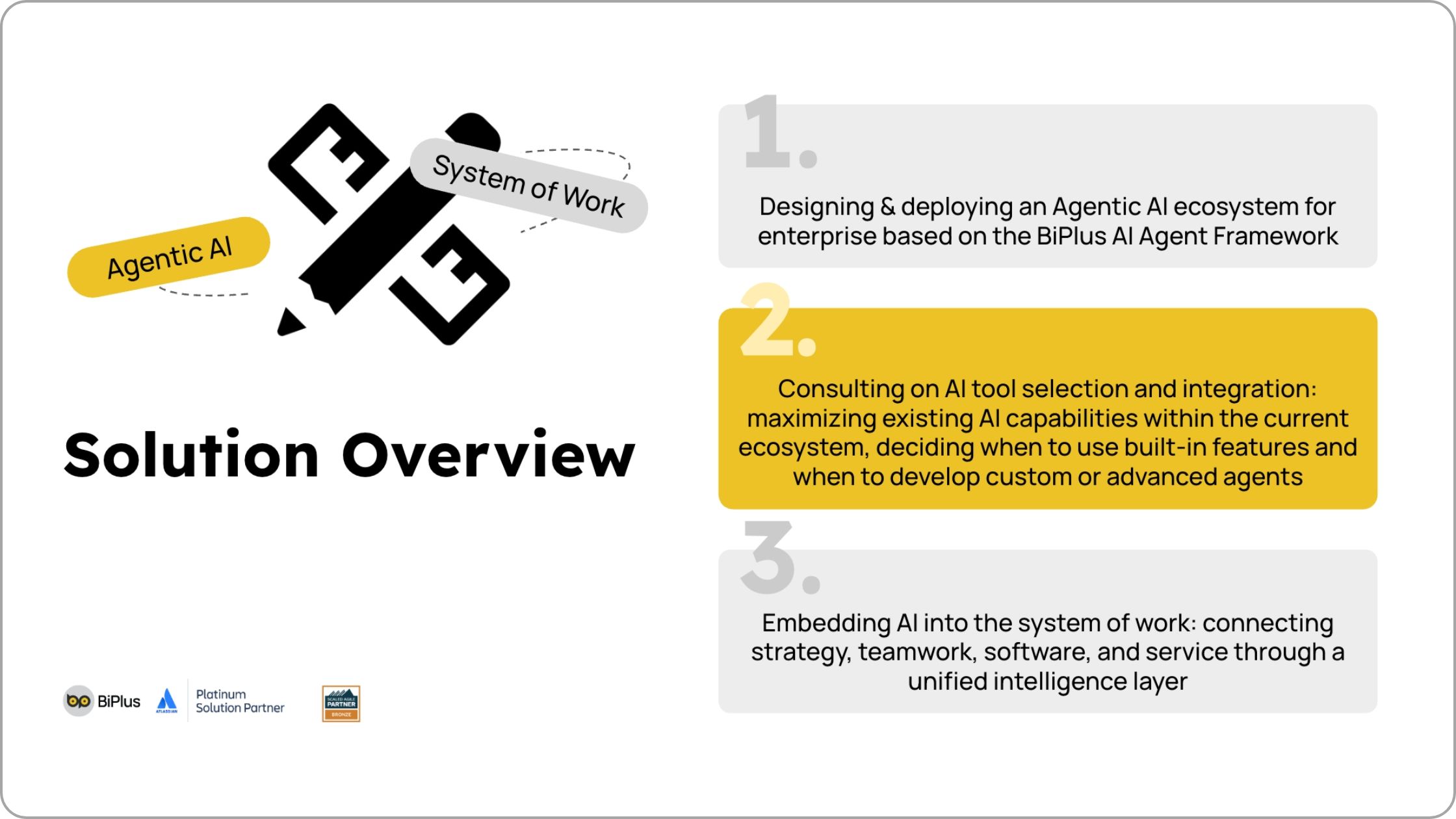
What sets BiPlus's solution apart is the ability to embed AI throughout the entire System of Work, seamlessly connecting strategy, teamwork, software, and services through a unified intelligence layer. As a result, AI is no longer a set of isolated tools but becomes the operational brain that enhances organizational performance and adaptability.
This solution is especially suitable for businesses that have used BiPlus's AI-Native consulting and training services and want to bring AI into practical work, without being dependent on a single provider. With an open, flexible architecture that can be deployed on cloud, on-premise, or integrated with existing ecosystems, BiPlus helps businesses solve challenges such as SDLC, ITSM, CloudOps/AIOps, and enterprise operations, especially when traditional methods have reached their optimization limits.
BiPlus believes that Agentic AI will create a breakthrough for Vietnamese businesses in 2026 and is ready to accompany customers from strategic consulting and solution implementation to building an autonomous, safe, efficient, and sustainable AI ecosystem.
Are you ready for your business to break through with Agentic AI?
Contact BiPlus for consultation and discover the most suitable AI-Native transformation roadmap for your organization!